
Would you like to know what a TruSEO suggestion is actually asking you to do?
All in One SEO reviews your content against a set of named checks and tells you which ones need attention.
In this guide, we’ll walk you through how the recommendations are grouped, then cover the checks in each area.
Before you get started, make sure All in One SEO is installed and activated on your WordPress site.
In This Article
How the Recommendations Are Grouped
Your recommendations live in the AIOSEO Settings section below your post content, on the Optimization tab.
IMPORTANT:
The TruSEO Highlighter feature only works with the WordPress Block Editor (also known as Gutenberg) and the WordPress Classic Editor.
Support for page builders will be added in future releases.
There, the Content Optimization panel splits its checks across five areas: Keywords, Basics, Spelling, Readability, and Headline. Each one has its own tab across the top. Selecting a tab shows that area’s checks.
Each area sorts its checks into two groups. Improvements holds the checks worth your attention. Good holds the ones your content already passes.
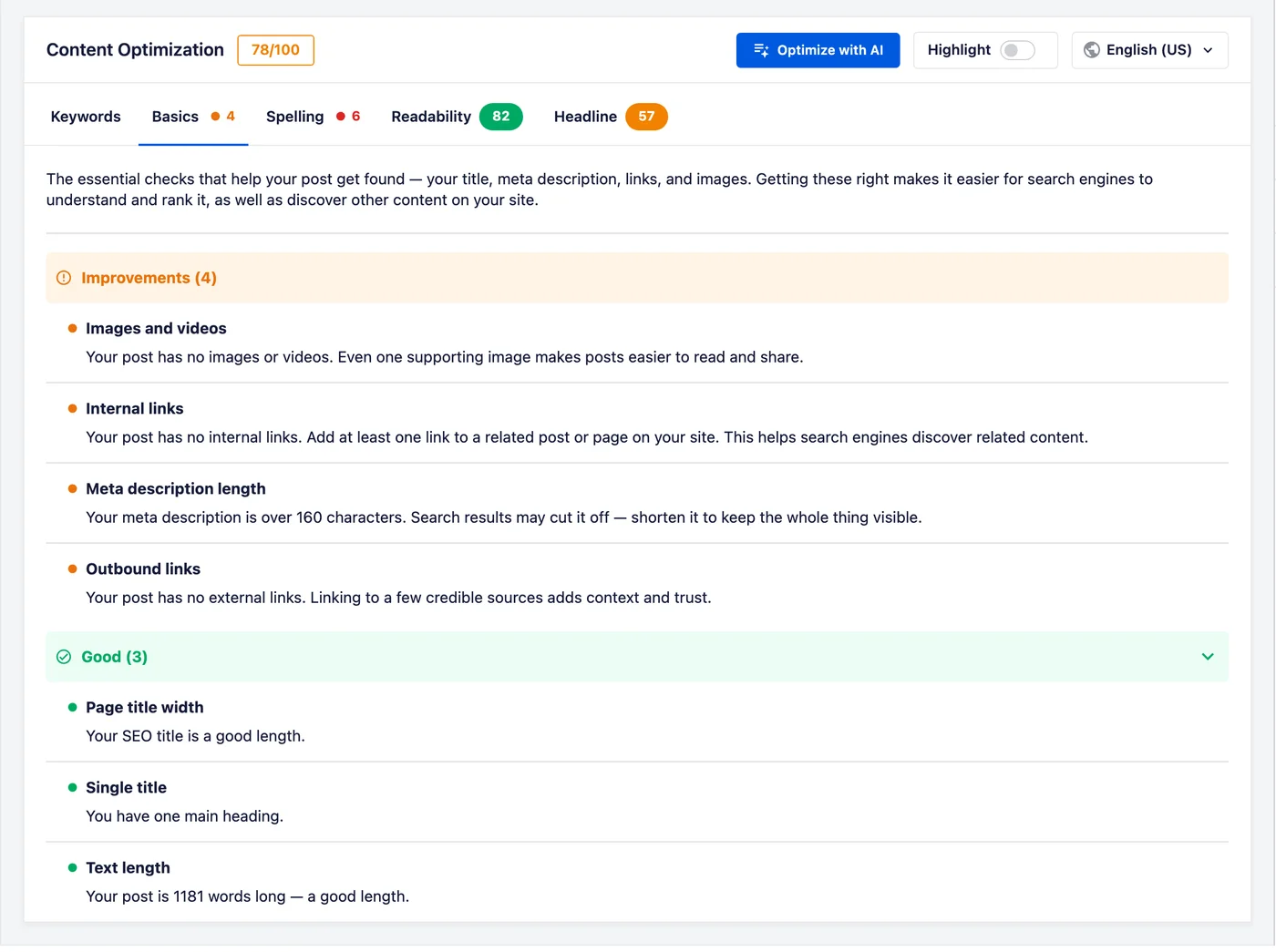
The Good group starts collapsed, so a post with plenty of passing checks still leads with the work that needs attention.
NOTE:
These are recommendations only, they are based on our best practices. You do not have to follow them rigidly if it means it will affect the quality of your content.
Your content quality is the primary ranking factor with all search engines and you shouldn’t change your content if you feel that it won’t benefit your audience. You know your audience better than anyone else.
Basics Checks
The Basics area covers the essentials that help a post get found, which are your title, your meta description, your links, and your images. Our guide on setting the SEO title and description for your content covers where you edit the first two.
The Basic checks are:
- Page title width: whether your SEO title fits in search results without being cut off. This check measures how wide your title renders rather than counting its characters.
- Single title: whether your post has one main heading rather than several competing ones.
- Text length: whether your post has enough content for search engines to understand its topic.
- Meta description length: whether your meta description fits in search results. Anything over 160 characters may be cut off by search engines.
- Internal links: whether you link to at least one related post or page on your own site, which helps search engines discover that content.
- Outbound links: whether you link out to any credible sources, which adds context and trust.
- Images and videos: whether your post has at least one image or video, since even one supporting visual makes a post easier to read and share.
Keyword Checks
Keyword checks run per keyword rather than per post. They sit inside each keyword’s own row on the Keywords tab rather than in a list of their own.
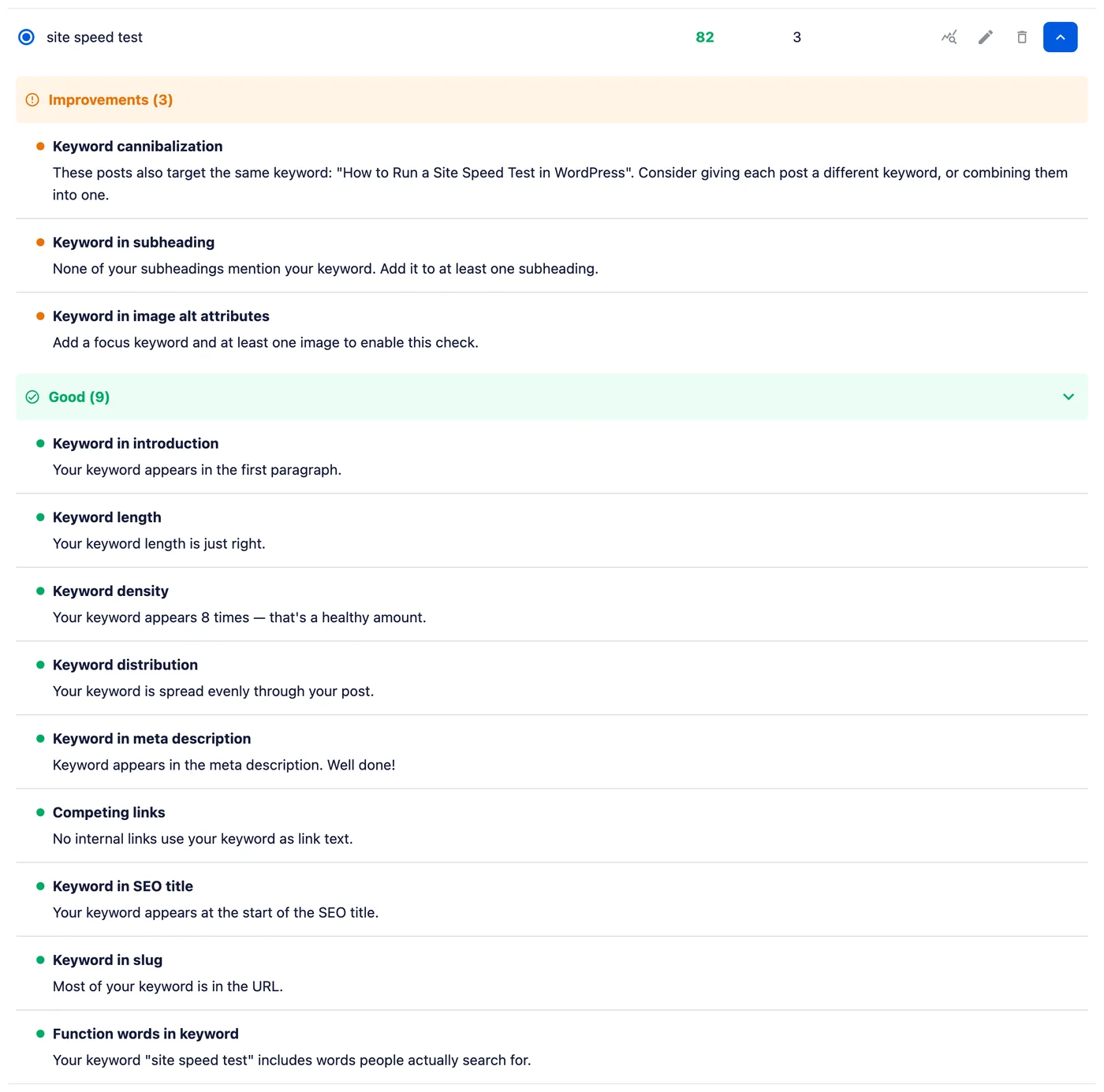
Each keyword you add carries its own set of recommendations, these are
- Keyword length: whether your keyword is a workable length. Shorter phrases are easier to target than long ones.
- Function words in keyword: whether your keyword is made up of words people actually search for.
- Keyword in SEO title: whether your keyword appears in your SEO title, and how early.
- Keyword in slug: whether your keyword appears in the post’s URL.
- Keyword in meta description: whether your keyword appears in your meta description.
- Keyword in introduction: whether your keyword appears in the first paragraph.
- Keyword in subheading: whether at least one subheading mentions your keyword.
- Keyword in image alt attributes: whether your images mention your keyword. This one needs a focus keyword and at least one image to run.
- Keyword density: how often your keyword appears, measured against what suits a post of that length. Using it too often can hurt readability and look spammy.
- Keyword distribution: whether your keyword is spread through the post rather than bunched in one place.
- Competing links: whether internal links on the post use your keyword as their link text, which points readers away from the post meant to rank for it.
- Keyword cannibalization: whether other posts on your site target the same keyword. When they do, the check names them so you can give each post a different keyword or combine them.
Some of these run only against your focus keyword. Those checks say so in their own text, so you’re never left guessing why one isn’t running.
Readability Checks
The Readability area scores how easy your writing is to follow. Our guidance is to aim for a score between 60 and 80 for most audiences.
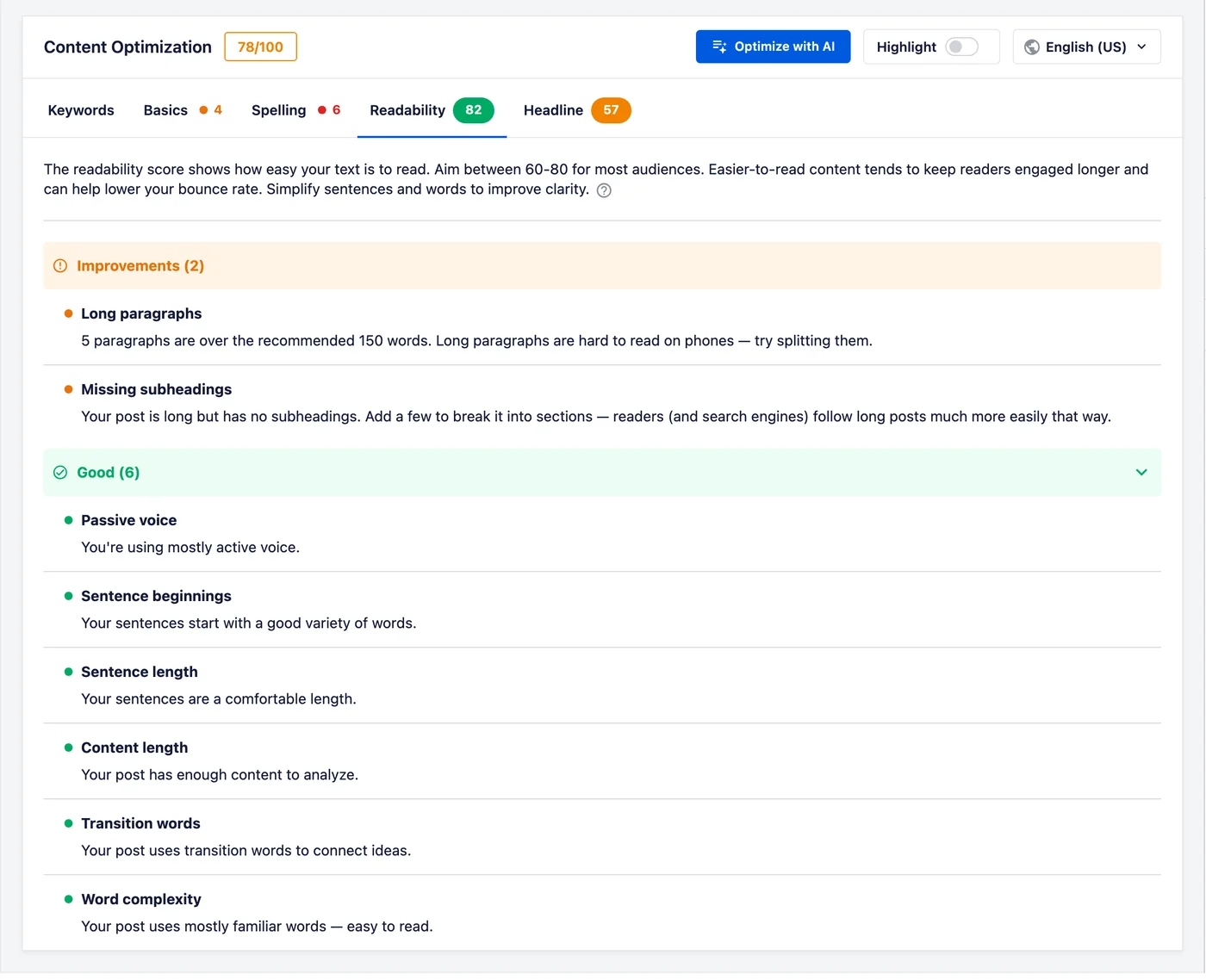
The checks here are:
- Content length: whether the post has enough text for the readability checks to mean anything.
- Sentence length: whether your sentences are a comfortable length, since long ones are harder to follow.
- Sentence beginnings: whether your sentences start with a variety of words. The check flags any run of sentences that opens with the same word, since repeated openings make a post feel monotonous.
- Long paragraphs: whether any paragraphs run past the recommended 150 words, since dense blocks of text are hard to read, especially on a phone.
- Missing subheadings: whether a long post is broken into sections. Subheadings help readers and search engines follow a long post.
- Passive voice: whether you’re writing mostly in active voice, which is usually clearer than passive.
- Transition words: whether your post uses words like however, because, and for example to help it flow from one idea to the next.
- Word complexity: whether you’re mostly using familiar words, since long or uncommon ones slow readers down.
Spelling
The Spelling area works differently from the others. Instead of pass or fail checks, it lists each misspelled word it finds in your content.
Each flagged word lists suggested corrections beneath it. To apply a correction, select it.
When a word is correctly spelled and you’d rather not see it flagged as a misspelling, then click the Add to dictionary button. This is useful for brand names, product names, and technical terms.
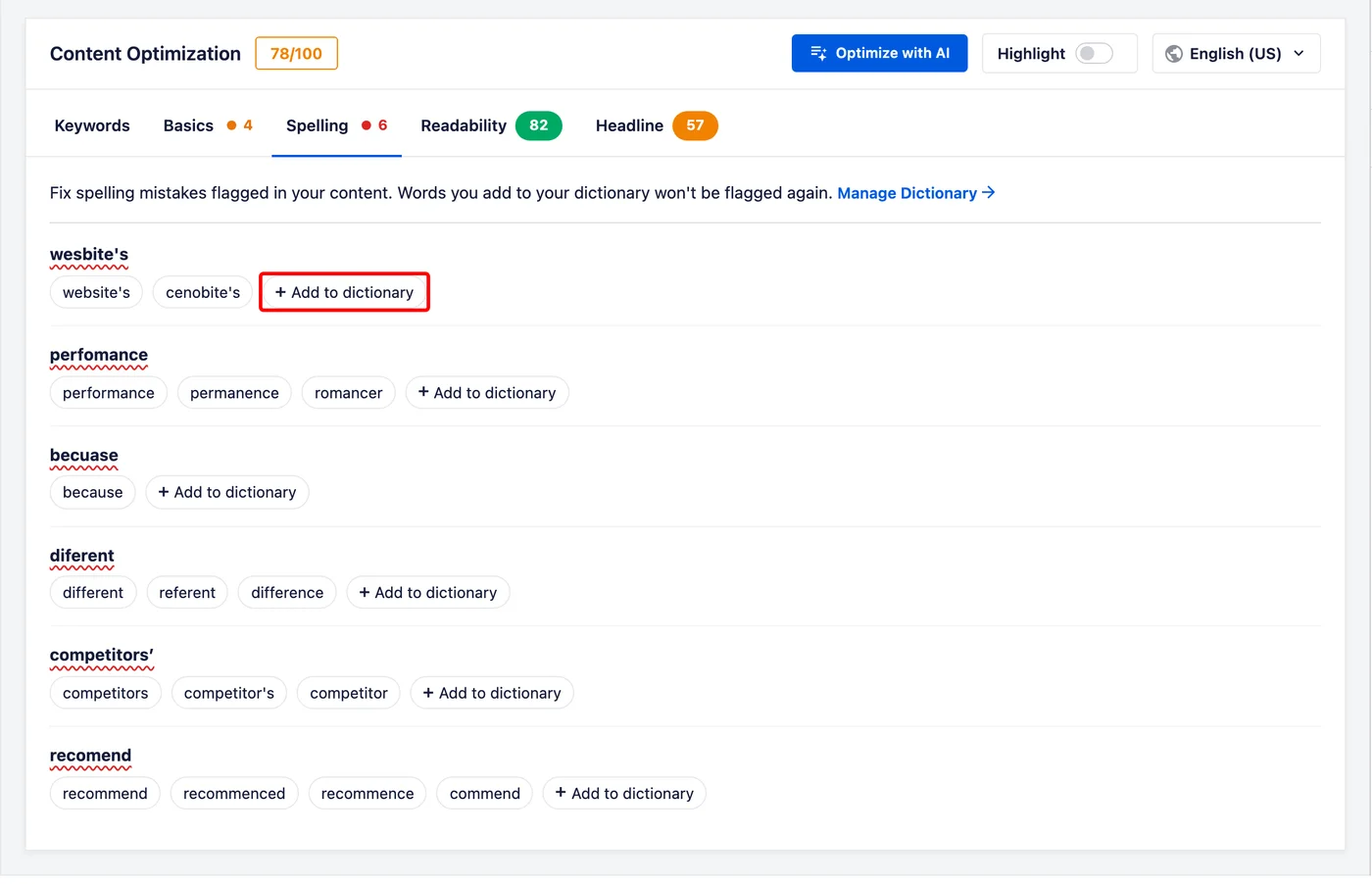
To review the words you’ve added, use the Manage Dictionary link at the top of the area.
Headline Checks
The Headline area scores how likely your post title is to earn clicks, and aims for a score of 70 or above. A score of 40 to 69 has room to improve, and a score below 40 needs work.
Its checks work as a breakdown rather than a list. They cover your word balance, the words your headline opens and closes with, its character and word counts, its sentiment, and its type. Our guide on using the Headline Analyzer covers each of those in depth.
That’s it! You now know what each TruSEO recommendation is checking and how to act on it.
Further Reading / Next Steps
For an overview of how the areas fit together and what the overall score means, read what TruSEO is. You can also browse all of our TruSEO content analysis documentation.
Frequently Asked Questions
Below, we’ve answered some of the most common questions about the recommendations:
Do I have to fix every recommendation?
No. They’re based on our best practices, and not every one suits every post. Work through the Improvements group and stop when the remaining suggestions would make your content worse for your readers.
Why can’t I see all the checks?
The Good group starts collapsed, so the checks your content already passes are tucked away. To see them, select the Good heading. The five areas each hold their own checks, so one you’re hunting for may sit on another tab.
See How the Recommendations Are Grouped above.
Where are the keyword checks?
Inside each keyword’s row on the Keywords tab, rather than in a list of their own. Keyword checks are scored per keyword, so each keyword carries its own set.
See Keyword Checks above.
A check says it needs a focus keyword. What does that mean?
A few checks only run against your focus keyword, which is the primary term you want the post to rank for. Our guide on using keywords to analyze your content covers how to set one.
The Spelling area flagged a word that’s correct. What now?
Beneath it, select Add to dictionary. That word won’t be flagged again, on this post or any other.
See Spelling above.