
Would you like to find and fix every broken link and image on your site from one screen?
Broken links frustrate your visitors and send search engines to dead ends. Broken Link Checker by AIOSEO watches the links on your site and tells you which ones need fixing.
In this guide, we’ll walk you through setting up Broken Link Checker, reading your results, and fixing broken links.
In This Article
- Installing Broken Link Checker
- Running the Setup Wizard
- Connecting Your Account
- Upgrading to a Paid Subscription
- Using the Dashboard in Broken Link Checker
- Using the Broken Links Report
- Filtering and Exporting the Report
- Fixing a Broken Link
- Cleaning Up Redirects
- Using Bulk Actions
- Choosing Your Settings
- Highlighting Broken Links on Your Site
- Other Places You'll See Broken Links
- Further Reading / Next Steps
- Frequently Asked Questions
IMPORTANT:
To check your links, Broken Link Checker needs a connected free or paid Broken Link Checker account. See below for details.
Installing Broken Link Checker
To get started, we’ll install Broken Link Checker from the WordPress plugin directory.
From your WordPress admin sidebar, go to Plugins > Add Plugin. Then search for “Broken Link Checker.”
Find Broken Link Checker by AIOSEO in the results. Then click the Install Now button.
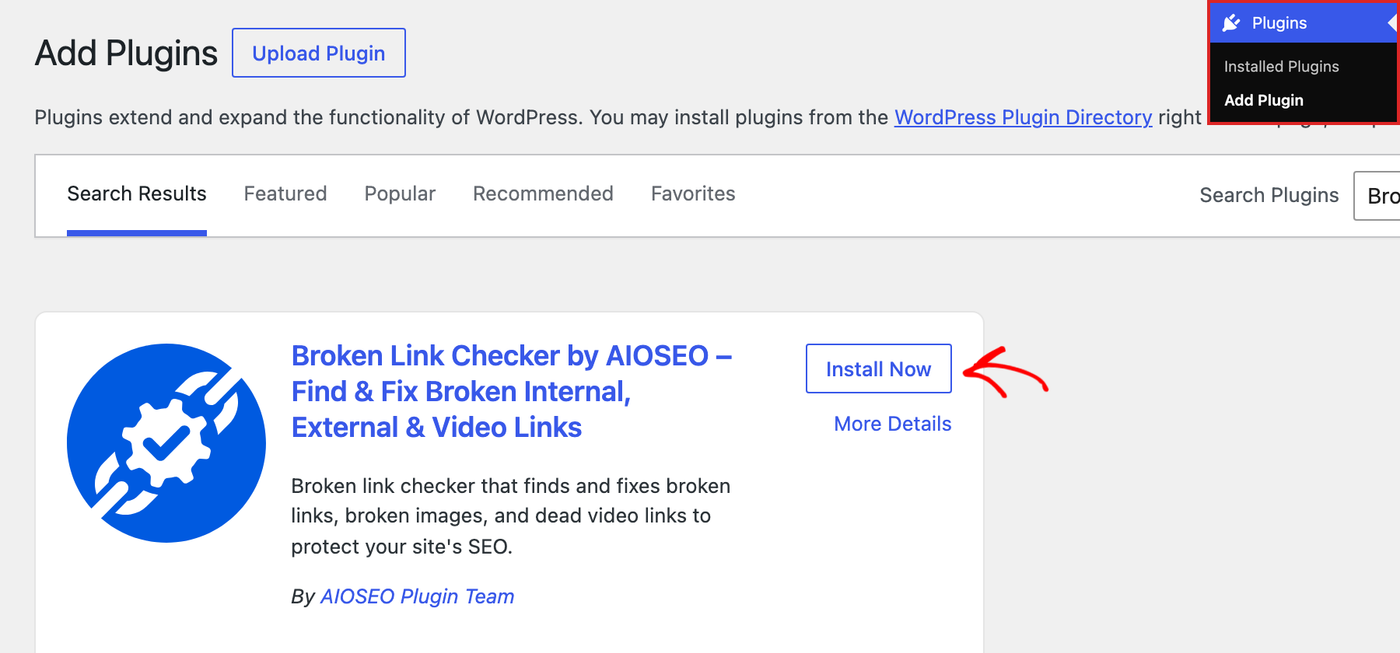
Once it’s installed, click the Activate button.
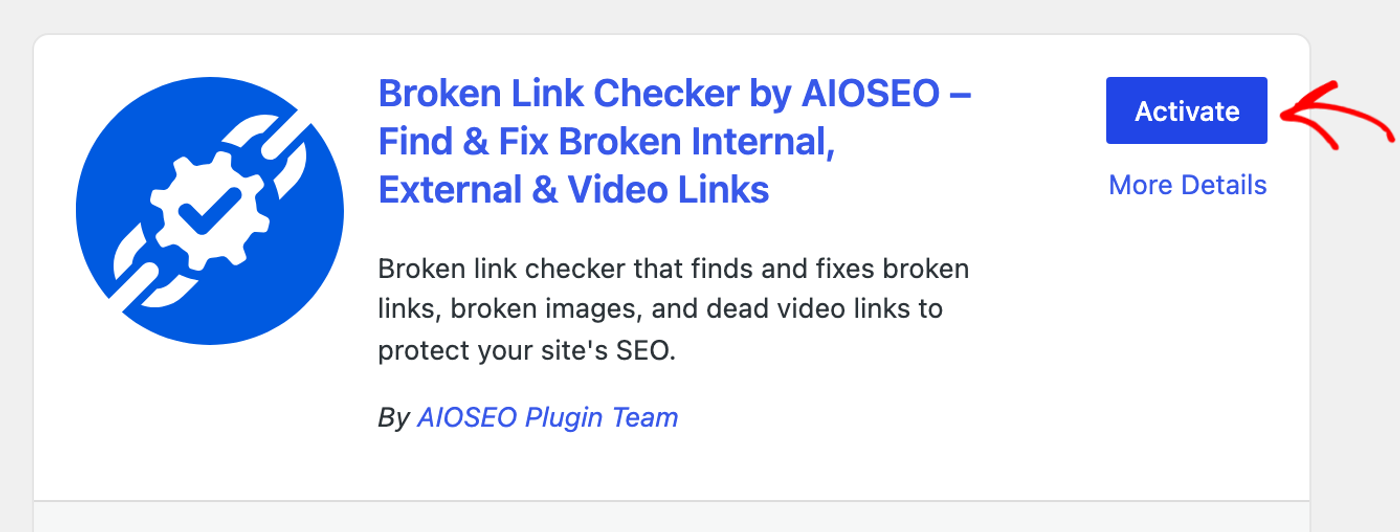
Broken Link Checker is now installed and active. Next, the Setup Wizard helps you get it ready.
Running the Setup Wizard
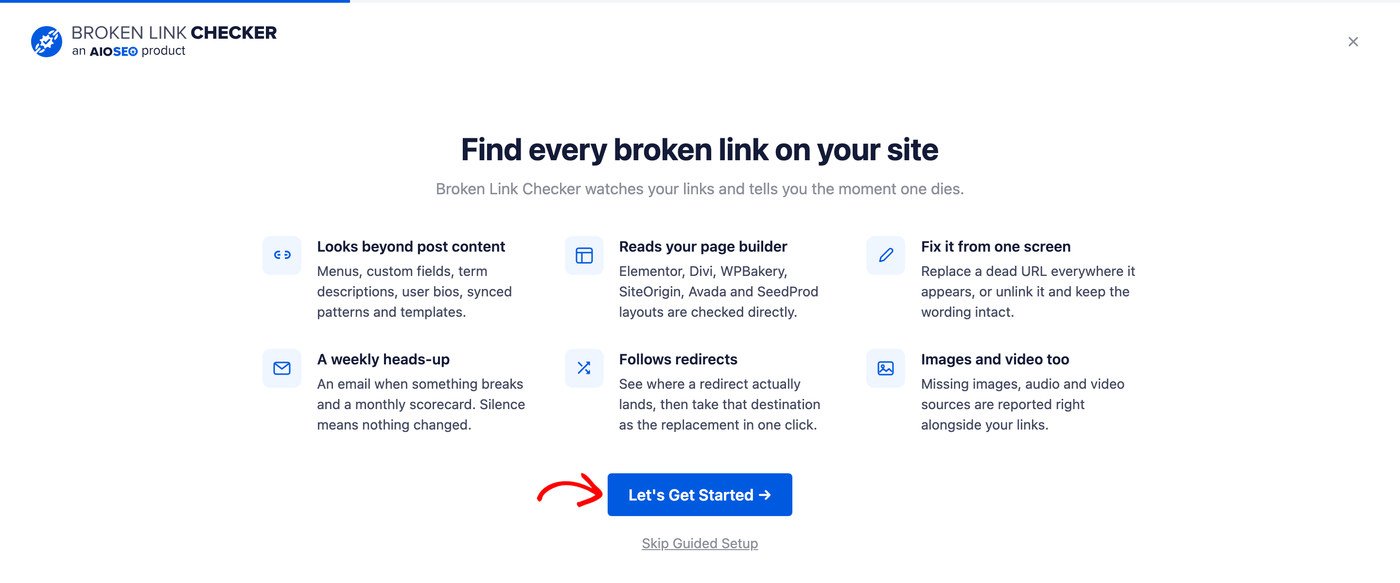
When you activate Broken Link Checker, the Setup Wizard opens. It walks you through connecting your account and choosing what to check.
The first screen shows what Broken Link Checker can do. To begin, click the Let’s Get Started button.
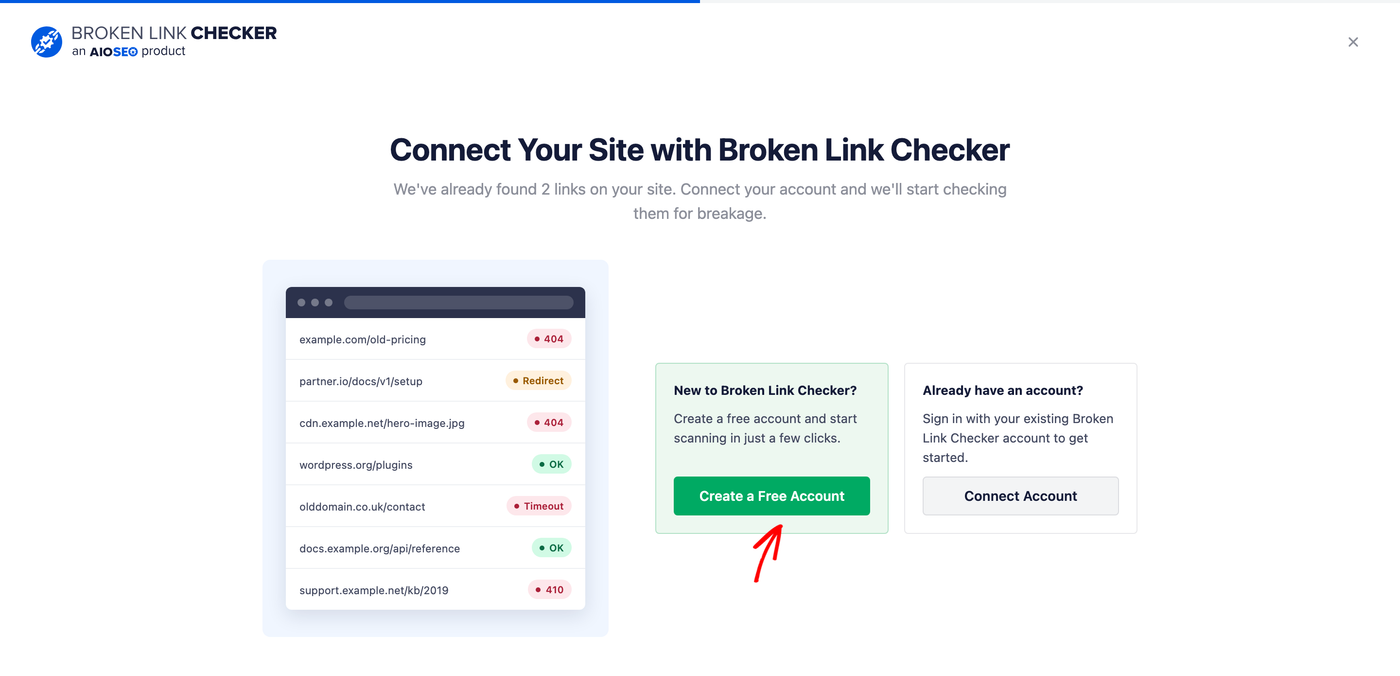
Next, connect your site to a Broken Link Checker account. Broken Link Checker finds the links on your site. It needs a connected account to check them.
To do this, click Create a Free Account if you’re new, or Connect Account if you already have an account. Then follow the steps on aioseo.com. The Save & Continue button unlocks once your account is connected.
For more on how accounts work, see Connecting Your Account below.
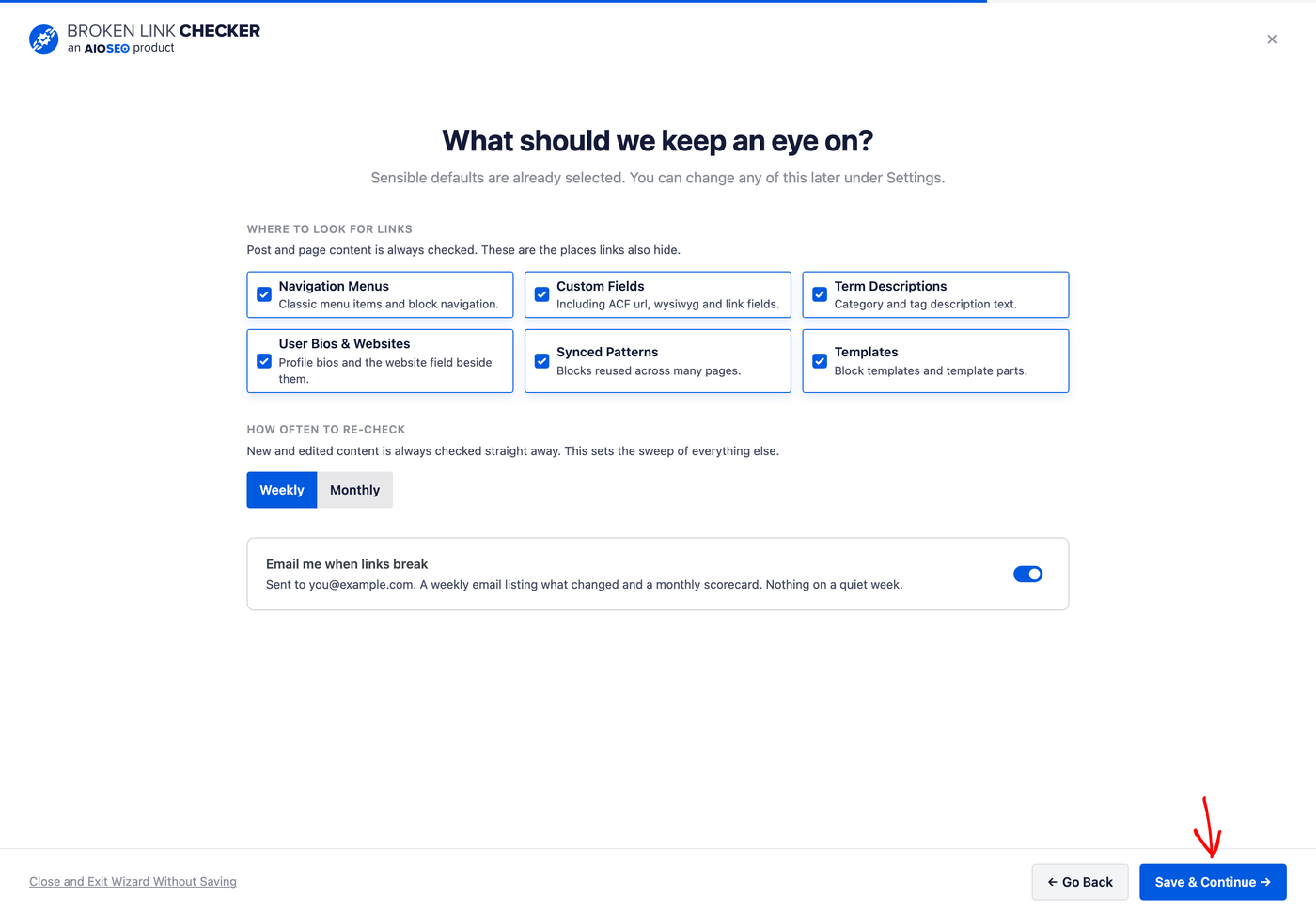
Then, choose what Broken Link Checker should keep an eye on. You can pick where to look for links, how often to check them again, and whether to get email reports.
The defaults suit most sites. You can change them later on the Settings tab. When you’re ready, click Save & Continue.
On the last screen, Broken Link Checker starts finding the links on your site. To see your results, click the View Your Report button.
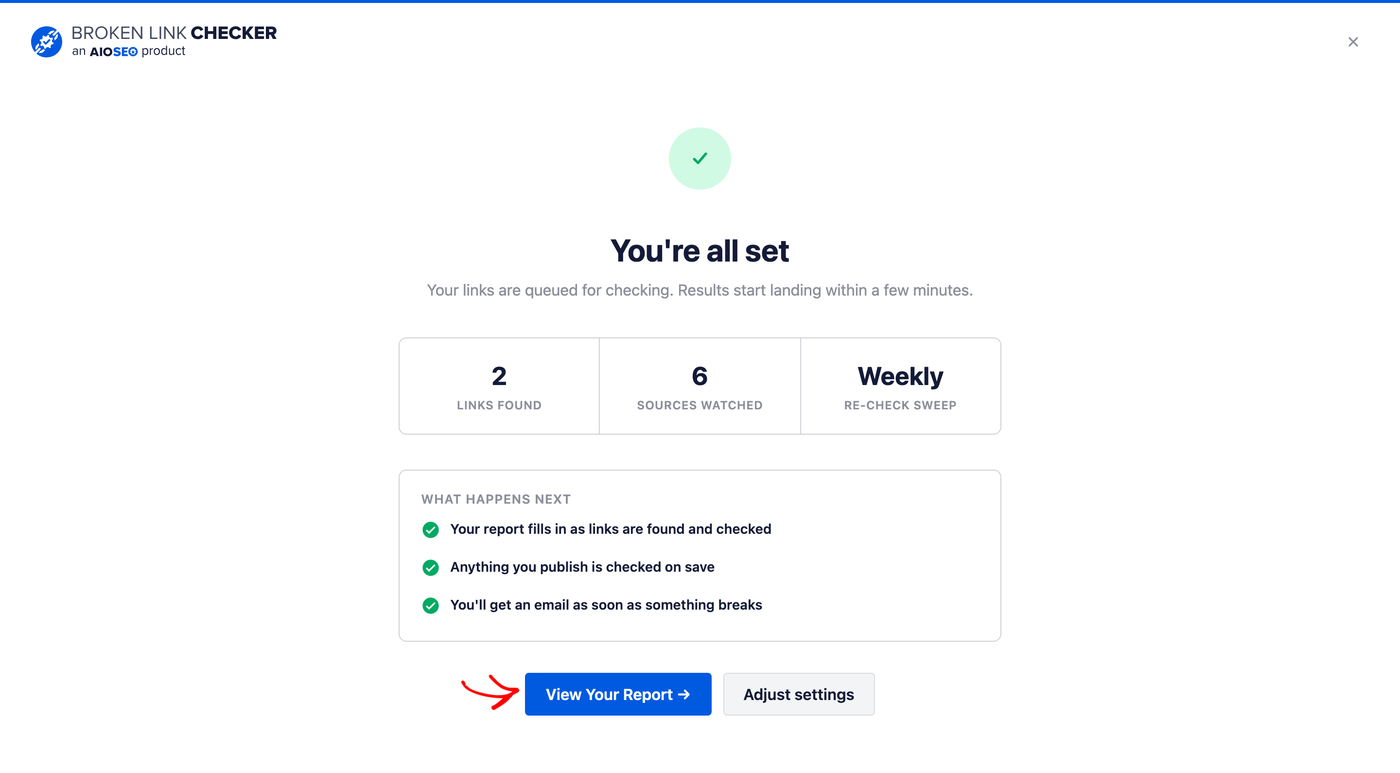
Broken Link Checker checks your links in the background. You can leave the page while it works. A small progress indicator at the top of each Broken Link Checker screen shows how far along it is.
If you closed the wizard before you connected your account, the next section shows you how to connect it later.
Connecting Your Account
NOTE:
If you already have an account for All in One SEO Pro, then you can connect to your existing account.
You will still need to add a new free or paid plan for Broken Link Checker to your existing account, as it is a separate, standalone product.
If you skipped the Setup Wizard, you can connect your account later.
From your WordPress admin sidebar, go to Broken Links > Dashboard. Then select the Settings tab.
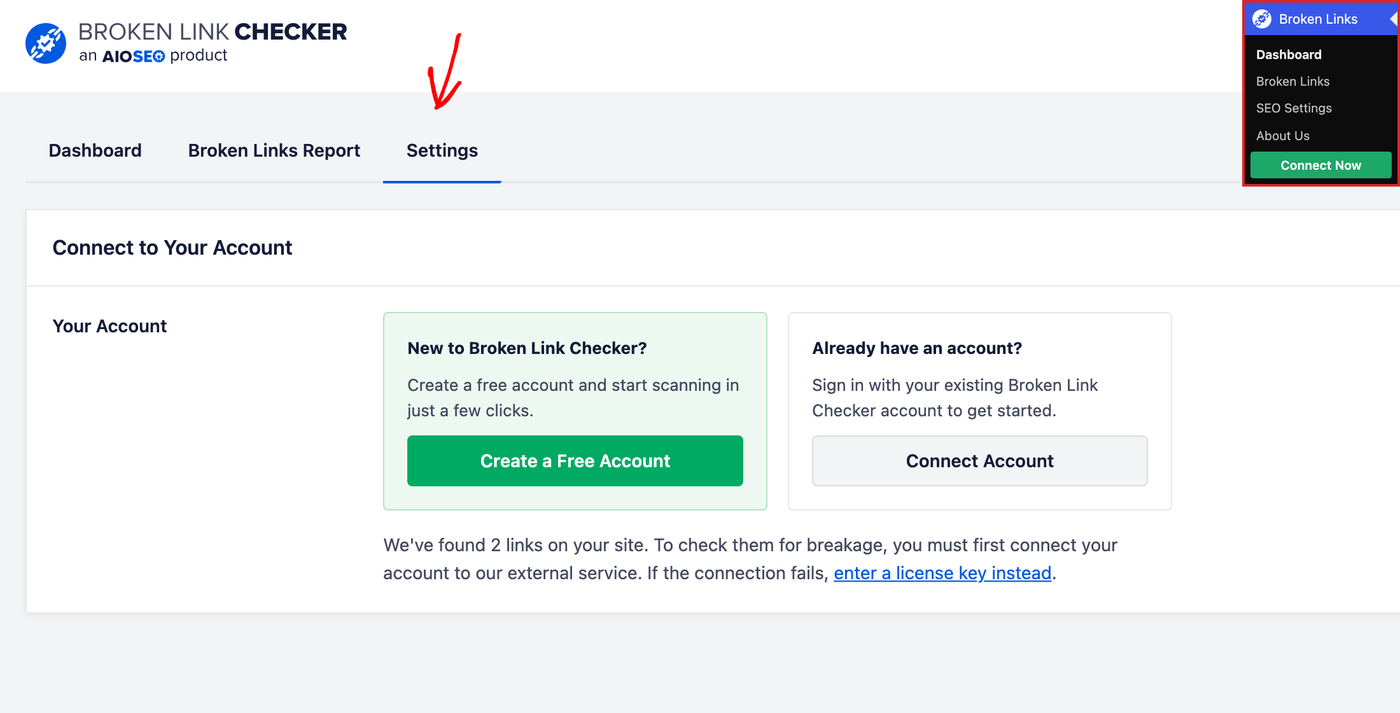
In the Connect to Your Account section, you’ll see these choices:
- Create a Free Account: Use this if you’re new to Broken Link Checker.
- Connect Account: Use this if you already have an account on aioseo.com.
If the connection fails, there’s also an enter a license key instead link below the buttons.
Follow the steps on aioseo.com to finish. When you come back, you’ll see Your account is connected! along with your plan and your link quota.
Your quota is the number of links Broken Link Checker checks each month. The free plan checks up to 250 links each month.
Each link counts once, however many times it’s checked. The count resets at the start of your billing month.
IMPORTANT:
Broken Link Checker is a free plugin that includes scanning of 250 internal and external links per month.
If you have more than 250 internal and external links, then you’ll automatically be upgraded to one of our monthly paid subscriptions so that we can check all of your links and images.
You can learn about our paid subscriptions and their features on our Pricing page here.
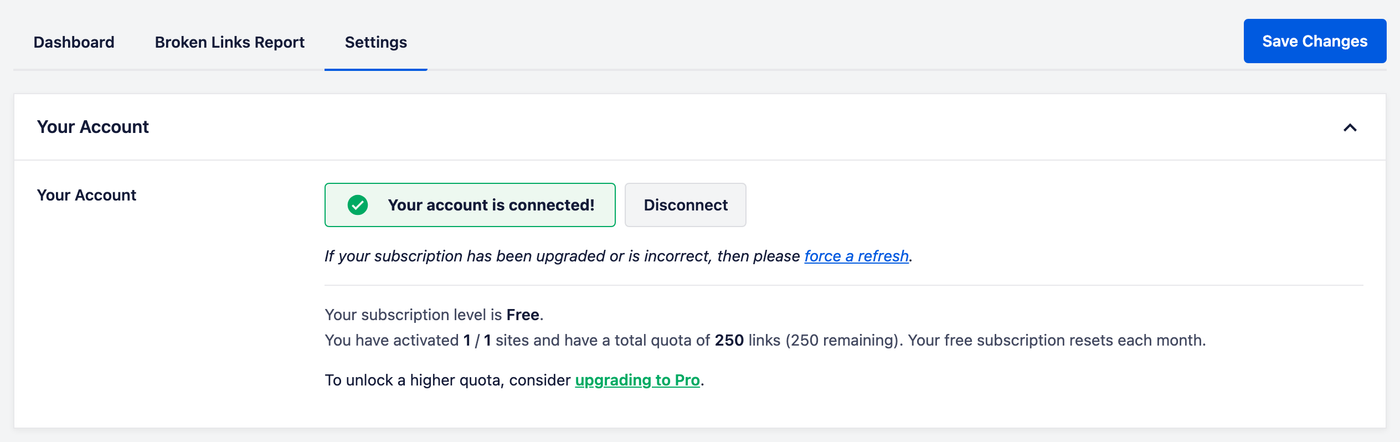
Once your account is connected, the Dashboard shows you how your links are doing.
Upgrading to a Paid Subscription
If you need to scan more than 250 links per month, then you can upgrade to one of our paid subscriptions which come with a higher number of links per month, checking of external links, and support from us when you need help.
You can find full details of our paid subscriptions on our Pricing page here.
To upgrade, click on the upgrading to Pro link shown on the Settings screen in Broken Link Checker.
You’ll see the Pricing page for Broken Link Checker where you can select the license level you want.
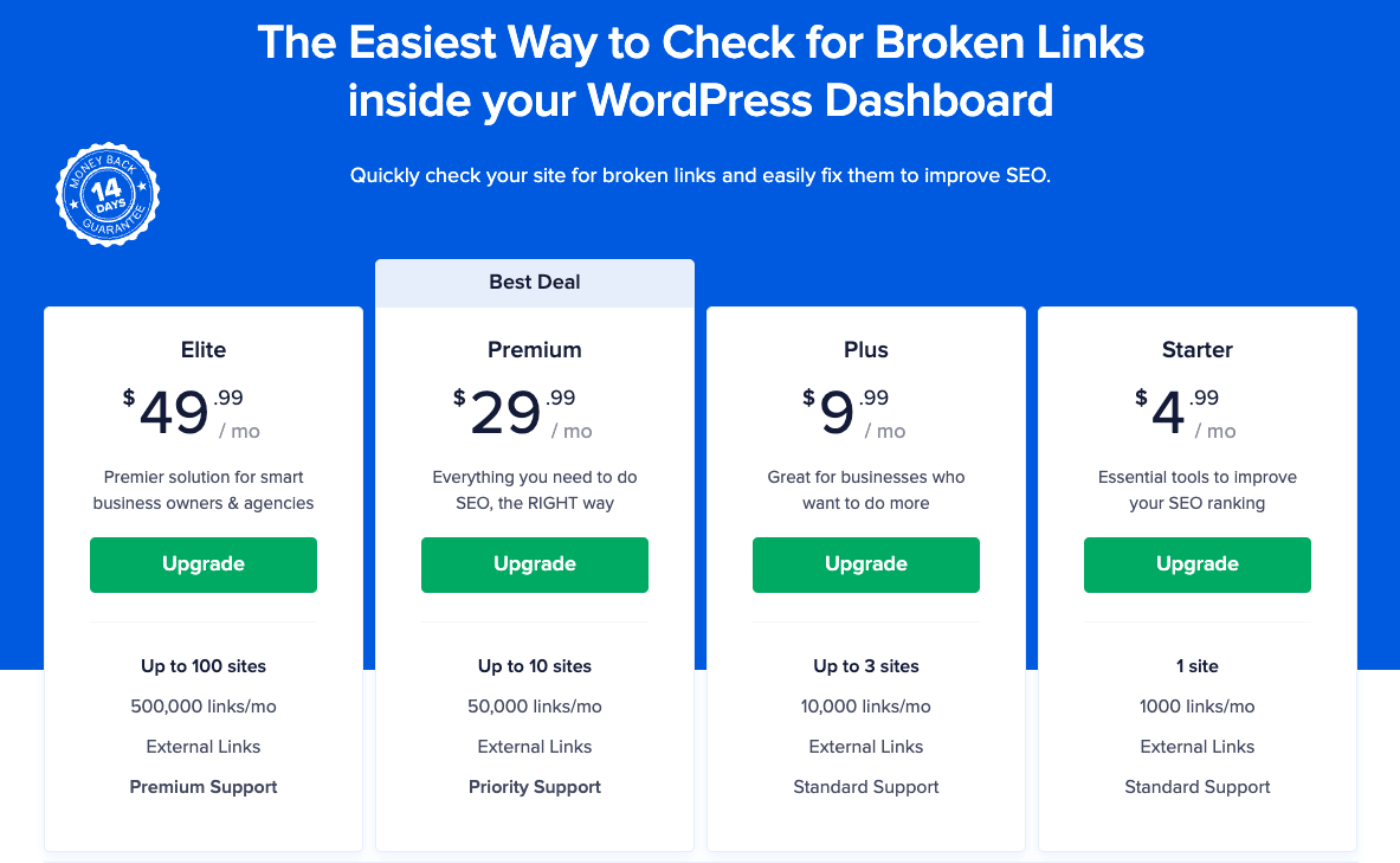
Click the Upgrade button for the license level you want.
You’ll now be prompted to enter payment information.
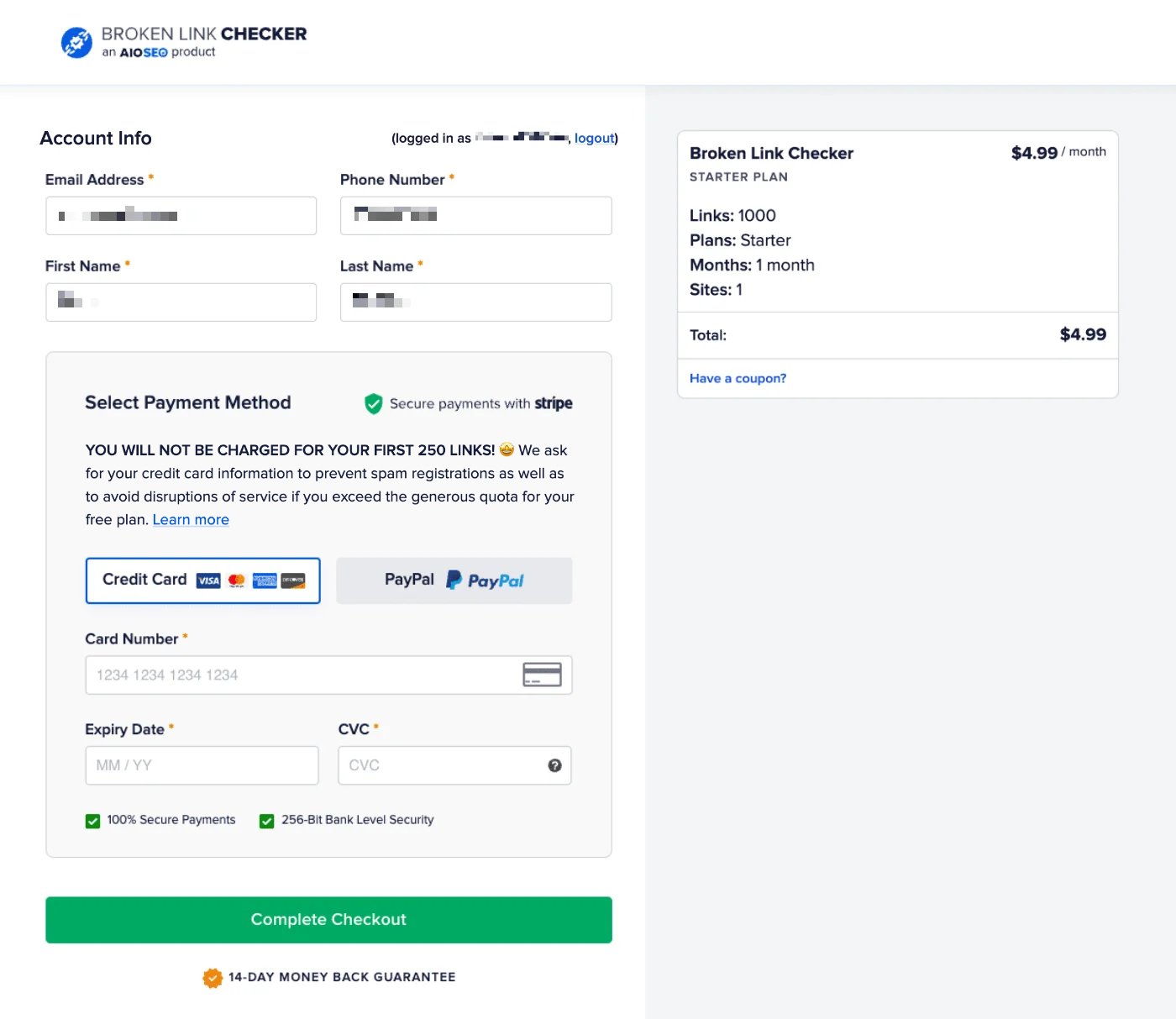
If you already have a payment method saved in your account, then you can select it, or enter new card details, or pay with PayPal.
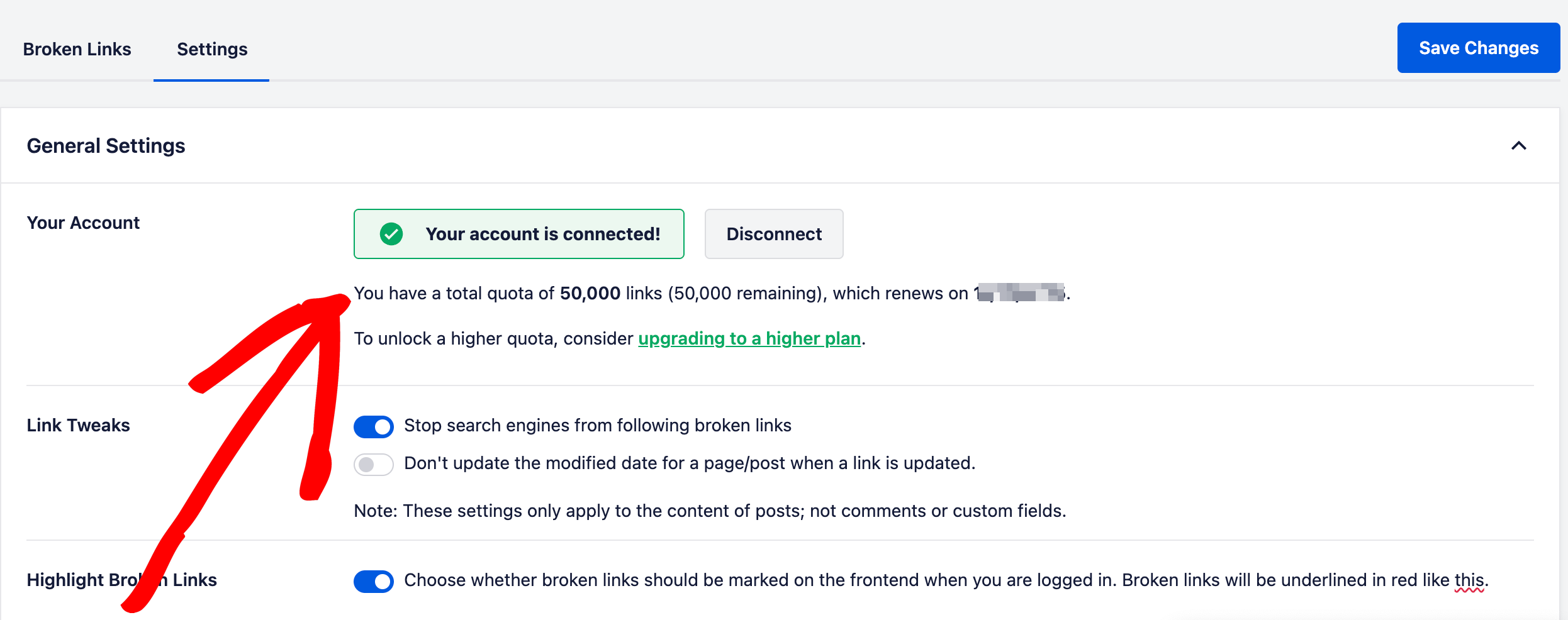
Once you’ve completed the Payment Method form, you’ll be returned to the Settings screen in Broken Link Checker, where it now says, “Your account is connected” and “You have a total quota of xxx links (xxx remaining), which renews on xx/x/xxxx“.
Using the Dashboard in Broken Link Checker
The Dashboard is the best place to start when you want a quick view of your links.
From your WordPress admin sidebar, go to Broken Links > Dashboard.
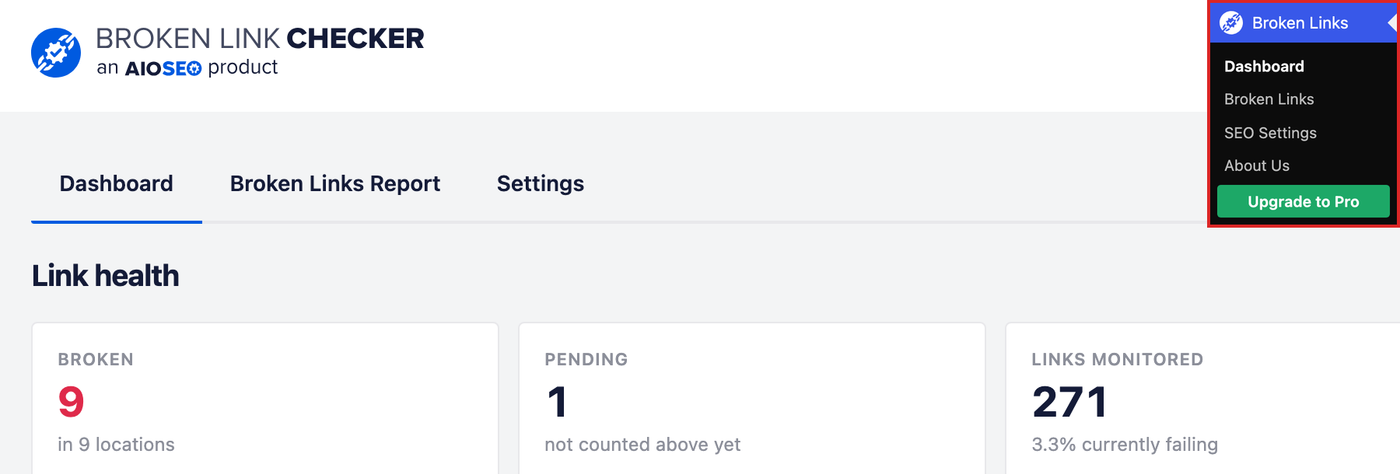
The Dashboard tab gives you a summary of your link health. It also shows which fixes will make the biggest difference.
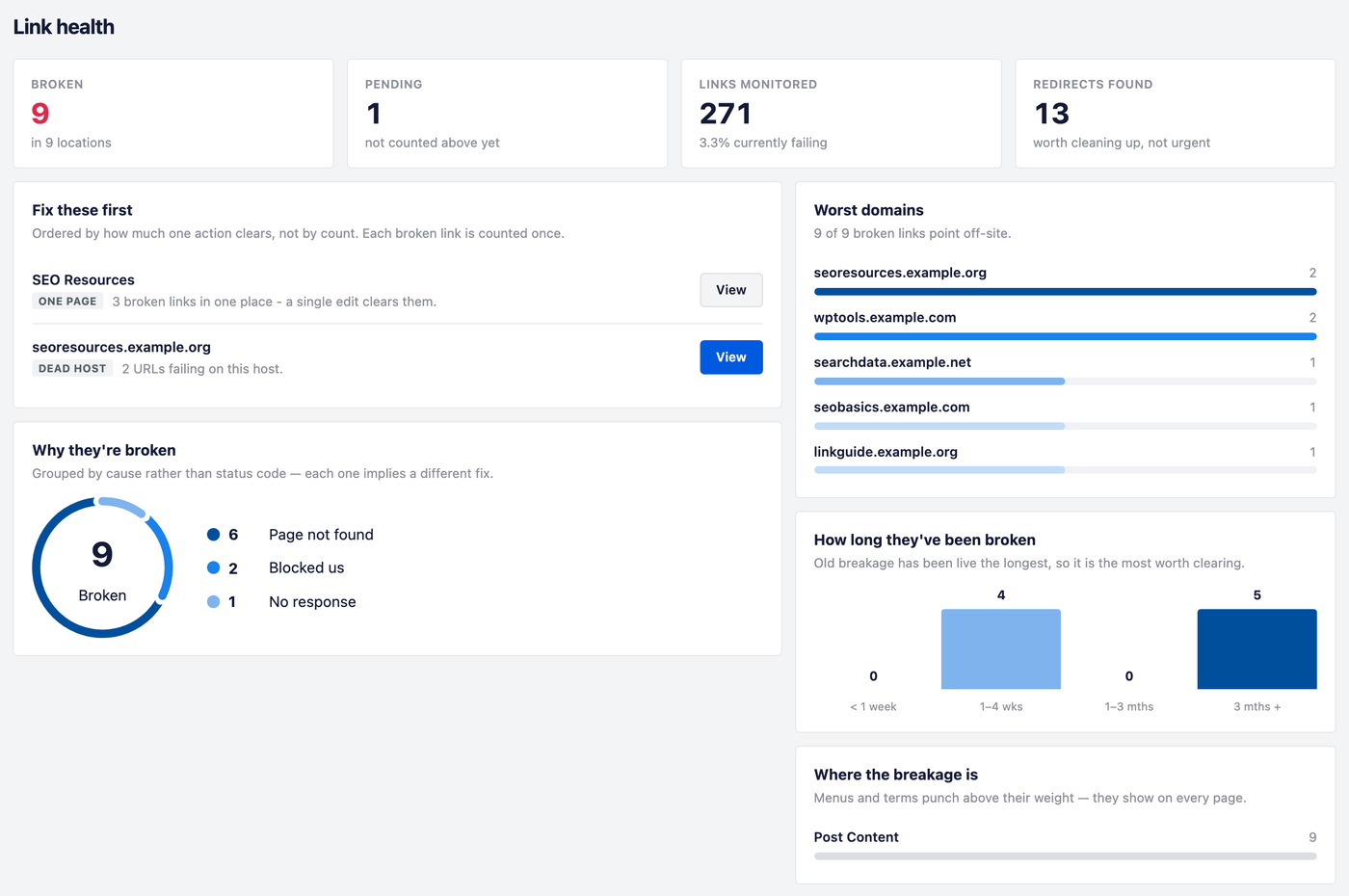
Across the top, you’ll see these totals:
- Broken: The number of broken links and how many places they appear.
- Pending: Links that haven’t been checked yet. This only shows while some links are waiting.
- Links Monitored: The number of links Broken Link Checker watches, and the share of them that are failing.
- Redirects Found: Links that still work but send visitors to a different address. These are worth cleaning up, but they aren’t urgent.
Each total also links to the matching list in the Broken Links Report.
Below the totals, you’ll find these cards:
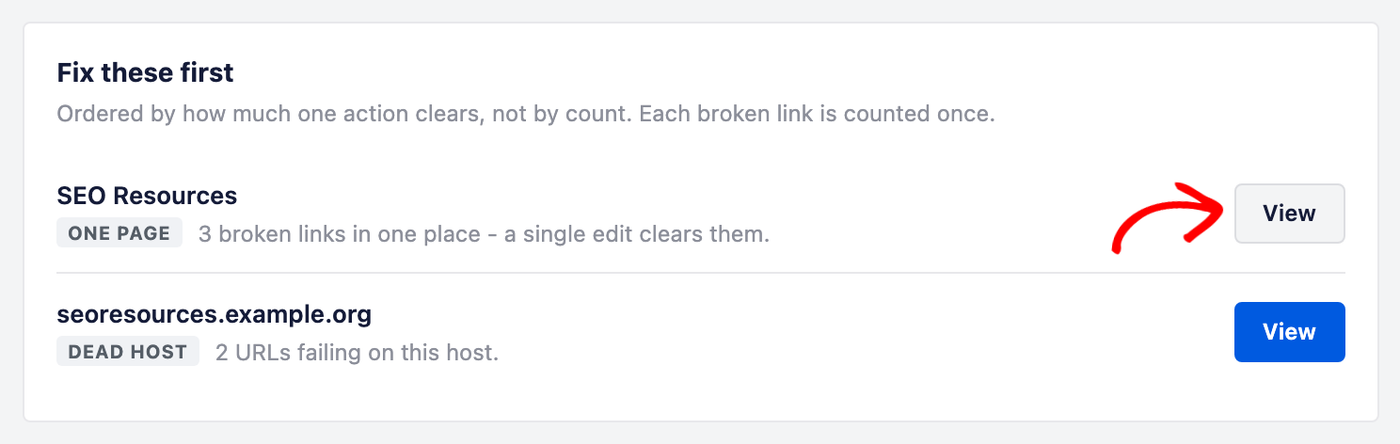
- Fix these first: Groups of broken links that one action can clear. For example, several broken links on one page, or several links to a site that no longer responds.
- Why they’re broken: Your broken links grouped by cause, such as Page not found, Blocked us, No response, or Server error. Each cause usually needs a different fix.
- Worst domains: The sites your broken links point to most often.
- How long they’ve been broken: Your broken links grouped by age. Old breakage has been live the longest, so it’s the most worth clearing.
- Where the breakage is: Where your broken links were found, such as post content or navigation menus. Broken links in menus are worth fixing early, because menus show on every page.
NOTE:
On a new site, these cards appear once enough of your links have been checked. Until then, the Dashboard shows the progress of your first check.
Each group in Fix these first has a button that takes you to the fix:
- For several broken links on one page, the View button opens that page in the editor. One edit clears them all.
- For other groups, the View button opens the Broken Links Report with just those links.
- For a group marked Not broken, the Dismiss all button hides those links from your results. This tag means a site refused our check rather than reporting a missing page, so the links most likely work.
Now that you know which fixes matter most, you’re ready to work through them in the Broken Links Report.
Using the Broken Links Report
The Broken Links Report tab lists every link Broken Link Checker has found. To see only the links that need fixing, click the Broken filter at the top.
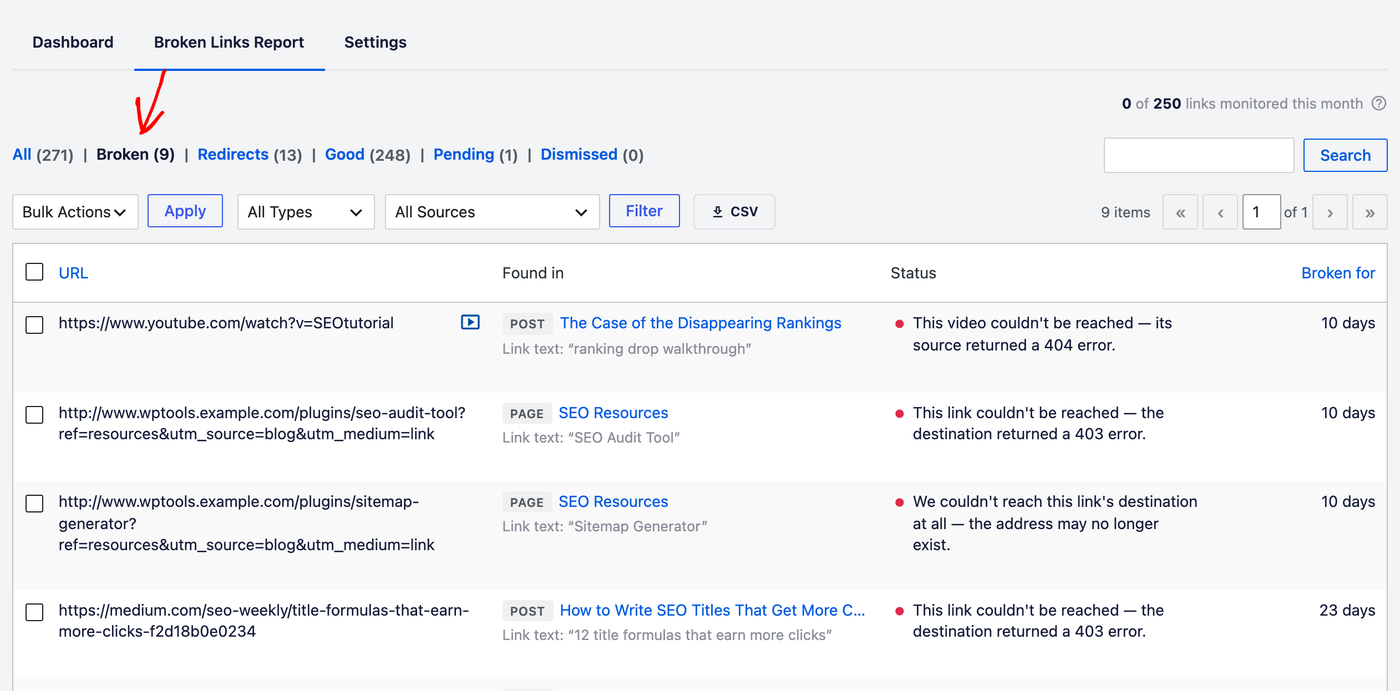
The filters across the top are:
- All: Every link on your site.
- Broken: Links that don’t work.
- Redirects: Links that work but redirect to a different address.
- Good: Links that work.
- Pending: Links waiting to be checked.
- Dismissed: Links you’ve chosen to ignore.
The report shows these columns:
- URL: The address the link points to. An icon marks links to images and videos.
- Found in: Where the link is, such as a post, page, menu, or user profile. It also shows the link text, or the alt text for an image.
- Status: Whether the link works. For broken links, it explains what went wrong.
- Broken for: How long the link has been broken. With the other filters, this column shows Last checked instead.
On a large site, the report can hold a lot of links, so it helps to narrow it down.
Filtering and Exporting the Report
To narrow the list, choose from the dropdowns above the table. Then click the Filter button. To download the list as a spreadsheet, click the CSV button.

The dropdowns are:
- All Types: Choose Internal Links, External Links, Non-Media, Images, or Videos.
- All Sources: Choose where the link was found, such as Post Content, Navigation Menus, or Custom Fields.
The CSV file includes only the links that match your current filters and search. To find a link by any part of its address, use the search box at the top right of the report.
Once you’ve found a broken link, you’re ready to fix it.
Fixing a Broken Link
To see your options for a link, hover over its row. A set of actions appears under the URL.
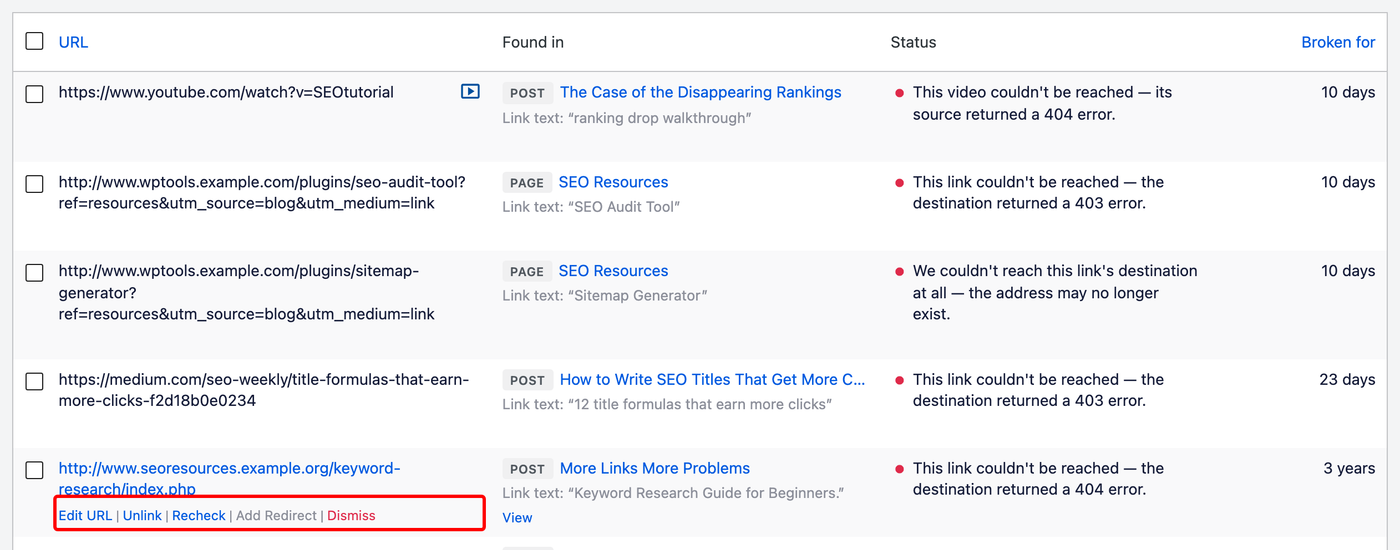
The actions are:
- Edit URL: Replace the broken address with a working one.
- Unlink: Remove the link but keep its text in your content.
- Remove menu item: For links in a navigation menu, delete the menu item.
- Recheck: Check the link again now. This is useful after you fix the page it points to.
- Add Redirect: Send visitors from a broken address on your own site to a working page. This needs All in One SEO with the Redirection Manager. To learn more, see how to redirect a post or page in All in One SEO.
- Dismiss: Hide a link you don’t want to fix. You can bring it back from the Dismissed filter.
Unlink, Recheck, and Dismiss take effect right away, with no confirmation step.
To replace a broken address, click Edit URL.
In the Replace with field, enter the working address. You can also change the Link text. Then click the Update link button.
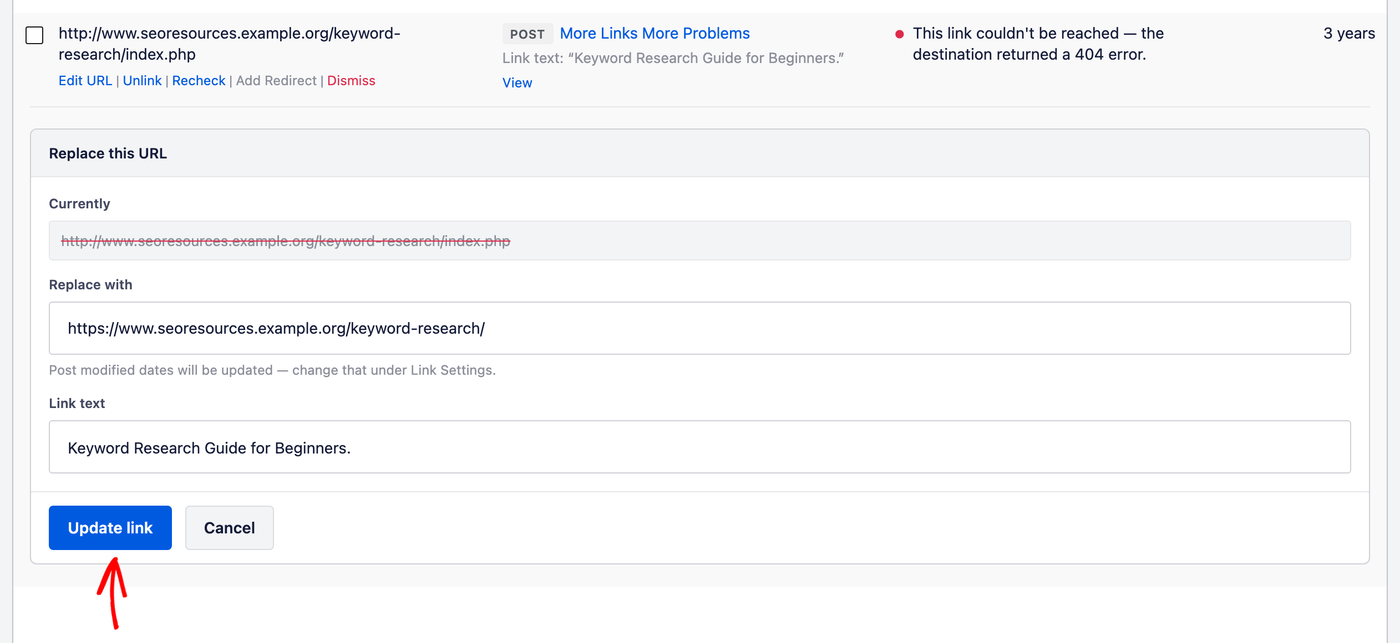
Broken Link Checker replaces the address everywhere that link appears on your site.
NOTE:
Broken Link Checker also finds links in content built with Elementor, Divi, WPBakery, SiteOrigin, Avada, and SeedProd. Those links show in the report. To change them, edit the page in your page builder.
Some links aren’t broken but still send visitors through a redirect. You can clean those up from the same report.
Cleaning Up Redirects
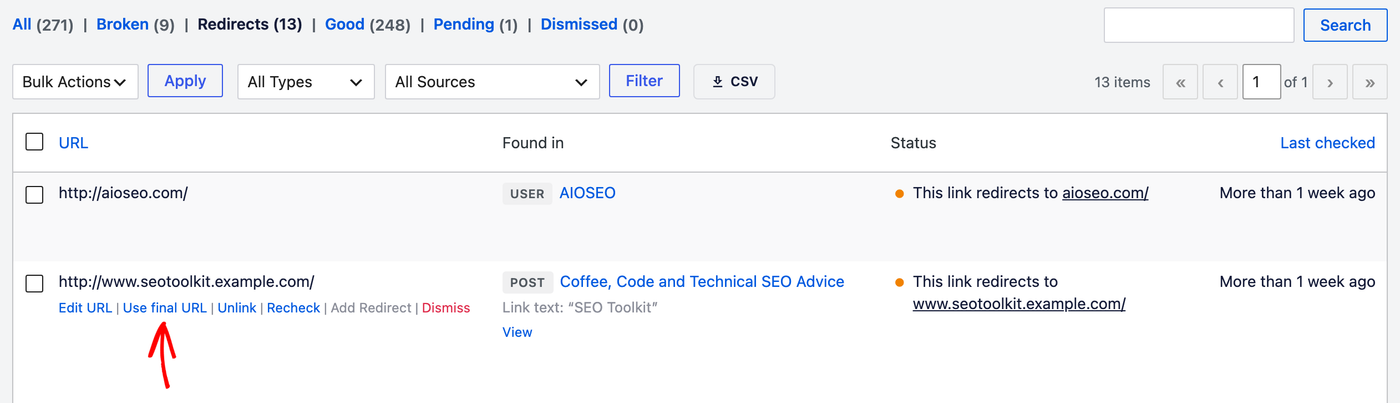
A redirected link still works. However, each redirect adds a small delay. To clean these up, click the Redirects filter.
Hover over a link and click Use final URL. This swaps the link for the address it redirects to.
If you have many links to work on, bulk actions save you time.
Using Bulk Actions
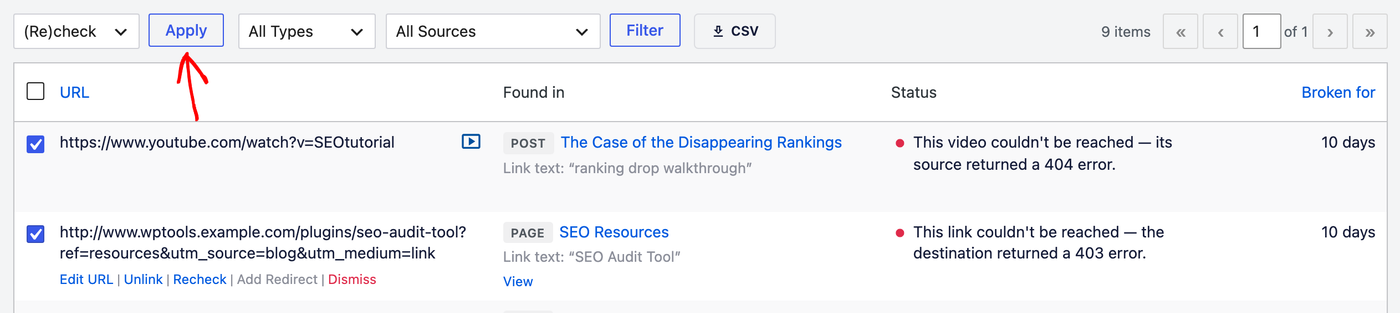
To act on several links at once, check the box next to each one. Then choose Unlink, (Re)check, or Dismiss from the Bulk Actions dropdown. Next, click the Apply button.
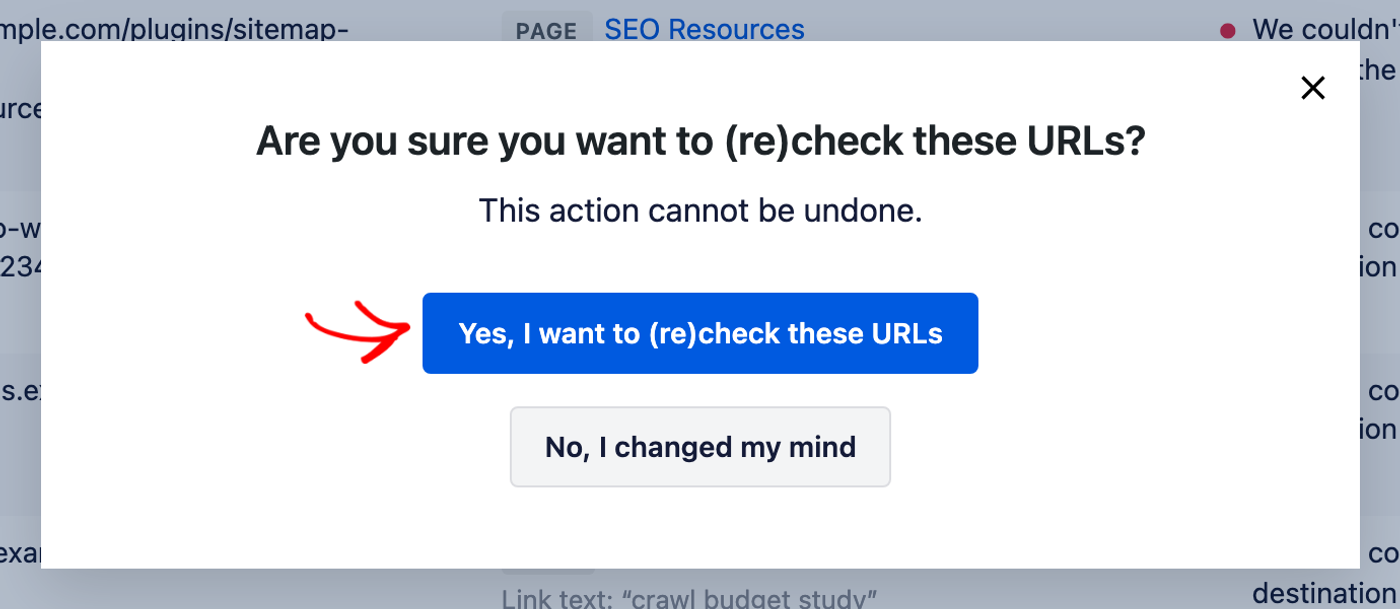
Broken Link Checker asks you to confirm before it applies a bulk action. To go ahead, click the button that starts with Yes, I want to.
Next, let’s look at the settings that control how Broken Link Checker works.
Choosing Your Settings
Once your account is connected, three more sections appear below Your Account: General Settings, Link Settings, and Advanced Settings. Together, they control how Broken Link Checker works.
General Settings
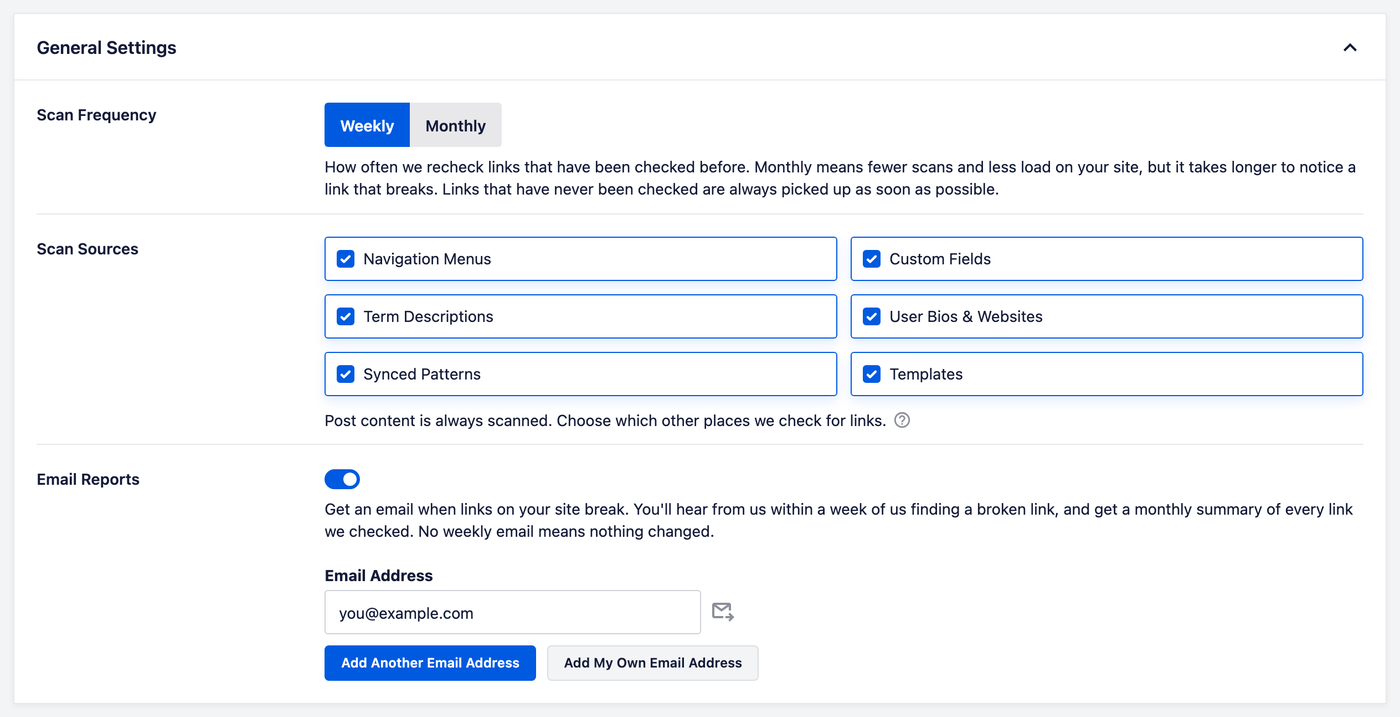
The General Settings section controls what Broken Link Checker scans and how it tells you about problems.
The settings are:
- Scan Frequency: How often Broken Link Checker checks links again. Choose Weekly or Monthly. It’s set to Weekly by default. Monthly puts less load on your site. It also takes longer to notice a link that breaks. New links are always checked as soon as possible.
- Scan Sources: The places Broken Link Checker looks for links, in addition to your post content. Post content is always scanned. All of these sources are checked by default. Uncheck a source to leave its links out of your report. Its past results are kept, so nothing is lost if you turn it back on.
- Navigation Menus: Links in your site’s menus, including block theme navigation.
- Custom Fields: Links saved in custom fields.
- Term Descriptions: Links in category and tag descriptions.
- User Bios & Websites: Links in user profile bios and website fields.
- Synced Patterns: Links in synced patterns you reuse across posts.
- Templates: Links in block theme templates and template parts.
- Email Reports: Get an email when links on your site break. This is on by default. We email you within a week of finding a broken link. You’ll also get a monthly summary of every link we checked. If you don’t get a weekly email, nothing changed.
NOTE:
If you set Scan Frequency to Monthly, you’ll only get the monthly summary.
To choose who gets the reports, enter an email address in the Email Address field. Add Another Email Address adds a field for one more person. Add My Own Email Address adds your own address. The envelope icon next to an address sends a test report. This lets you check that the reports reach you.
With your scanning and email reports set up, let’s move on to the link settings.
Link Settings
The Link Settings section controls how broken links behave on your site.
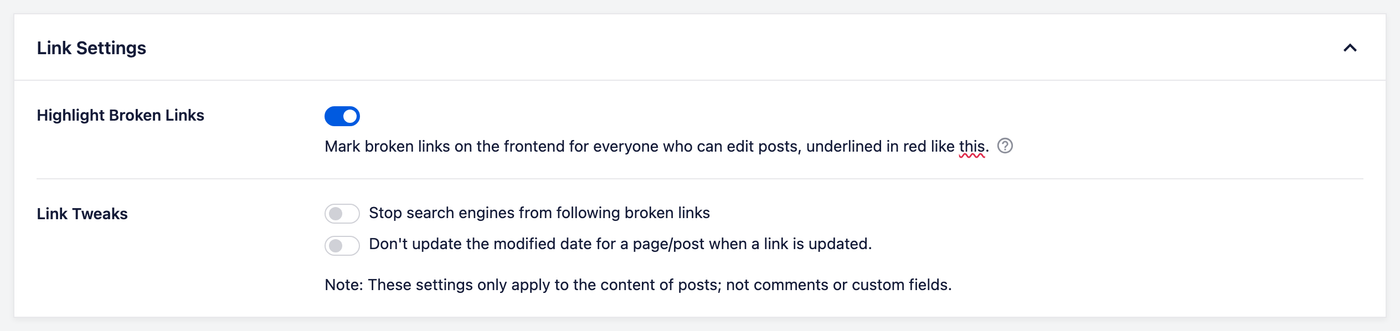
The settings are:
- Highlight Broken Links: This marks broken links on the front end of your site with a red underline. It’s on by default. Only logged-in users who can edit the post see it. See Highlighting Broken Links on Your Site below.
- Stop search engines from following broken links: This adds
rel="nofollow"to broken links so search engines don’t follow them to a dead page. It’s off by default, so your links keep their normal attributes until you turn it on. - Don’t update the modified date for a page/post when a link is updated: This keeps a post’s modified date the same when you fix one of its links. It’s off by default, so fixing a link updates the post’s modified date like any other edit.
The Link Tweaks settings apply to the content of your posts. They don’t apply to comments or custom fields.
For more control over what gets scanned, use the advanced settings.
Advanced Settings
The Advanced Settings section controls which content Broken Link Checker scans.
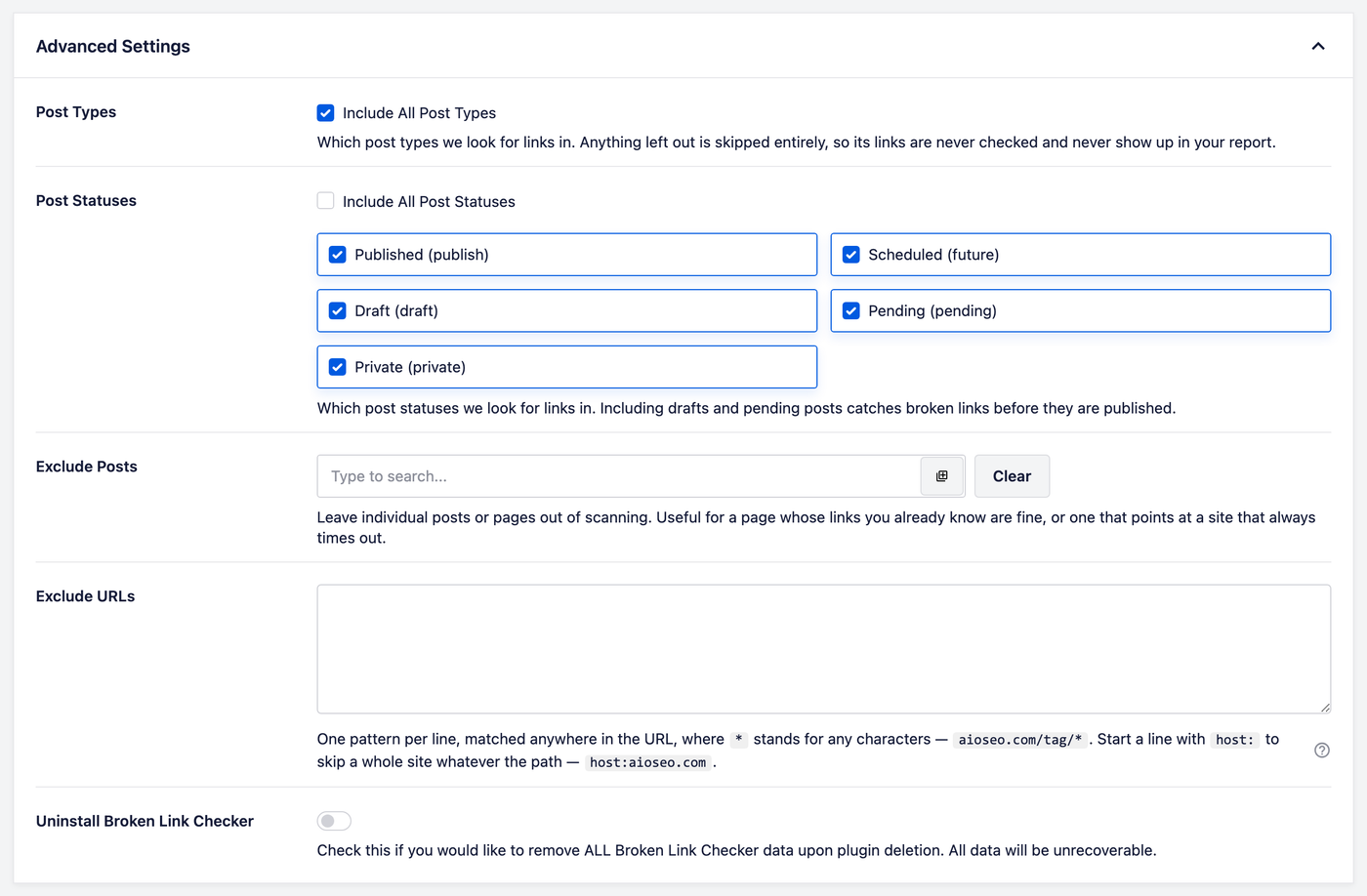
The settings are:
- Post Types: The types of content to scan. Include All Post Types is checked by default. Anything you leave out is skipped, so its links never show in your report.
- Post Statuses: The post statuses to scan. By default, Broken Link Checker scans published, draft, pending, scheduled, and private posts. Including drafts and pending posts catches broken links before you publish.
- Exclude Posts: Posts or pages to leave out of scanning. This is empty by default, so every post is scanned. It’s useful for a page whose links you know are fine, or one that links to a site that always times out.
- Exclude URLs: Addresses to leave out of scanning, one per line. This is empty by default, so every address is checked.
- Use
*to match any characters. For example,example.com/tag/*. - To skip a whole site, start the line with
host:. For example,host:example.com.
- Use
- Uninstall Broken Link Checker: Enable this to remove all Broken Link Checker data when you delete the plugin. It’s off by default, so your data stays in place if you delete and reinstall the plugin. Removed data can’t be recovered.
When you’re done with your settings, click the Save Changes button at the bottom of the screen.
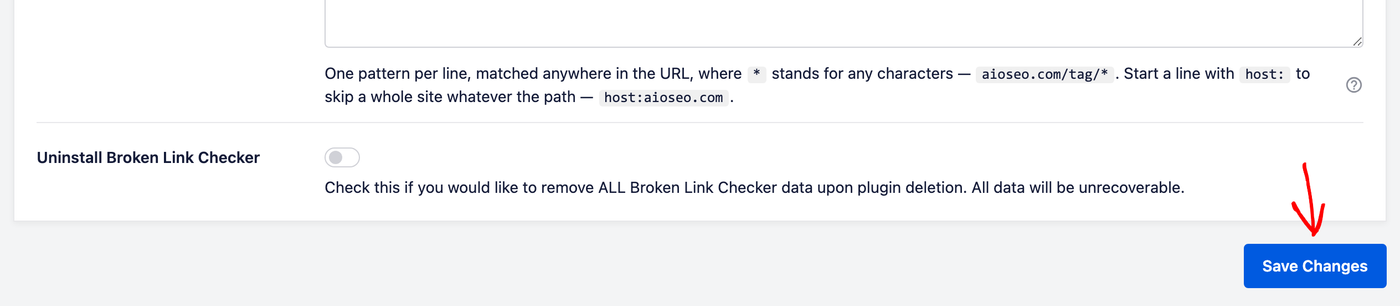
Your settings are now saved. Next, let’s see how highlighted broken links look on your site.
Highlighting Broken Links on Your Site
Highlight Broken Links is on by default, so you’ll see broken links underlined in red as you browse your site. Your visitors don’t see this.
To learn more about a broken link, hover over it. A card shows the address, the reason it’s broken, and an Open in report link.
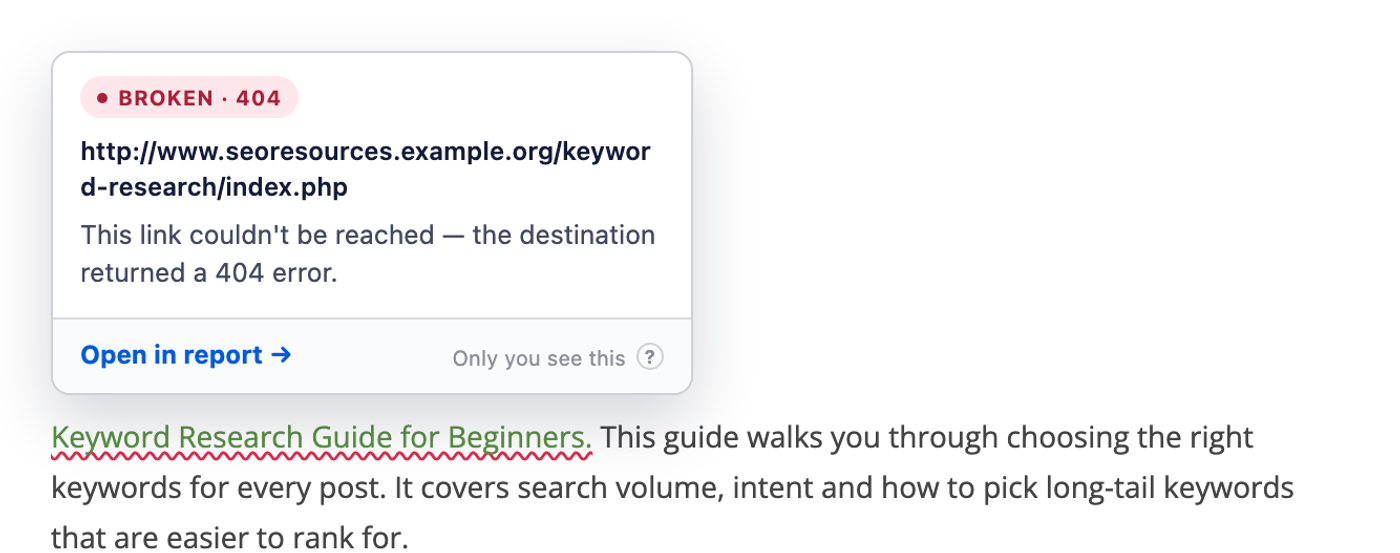
To hide the highlights for yourself only, use the Highlight switch in the WordPress toolbar at the top of the page. Its label shows how many broken links are on the page, such as “Highlight 1 broken link.” This switch only appears on pages with broken links.

Next, let’s look at the other places in WordPress where Broken Link Checker shows your broken links.
Other Places You’ll See Broken Links
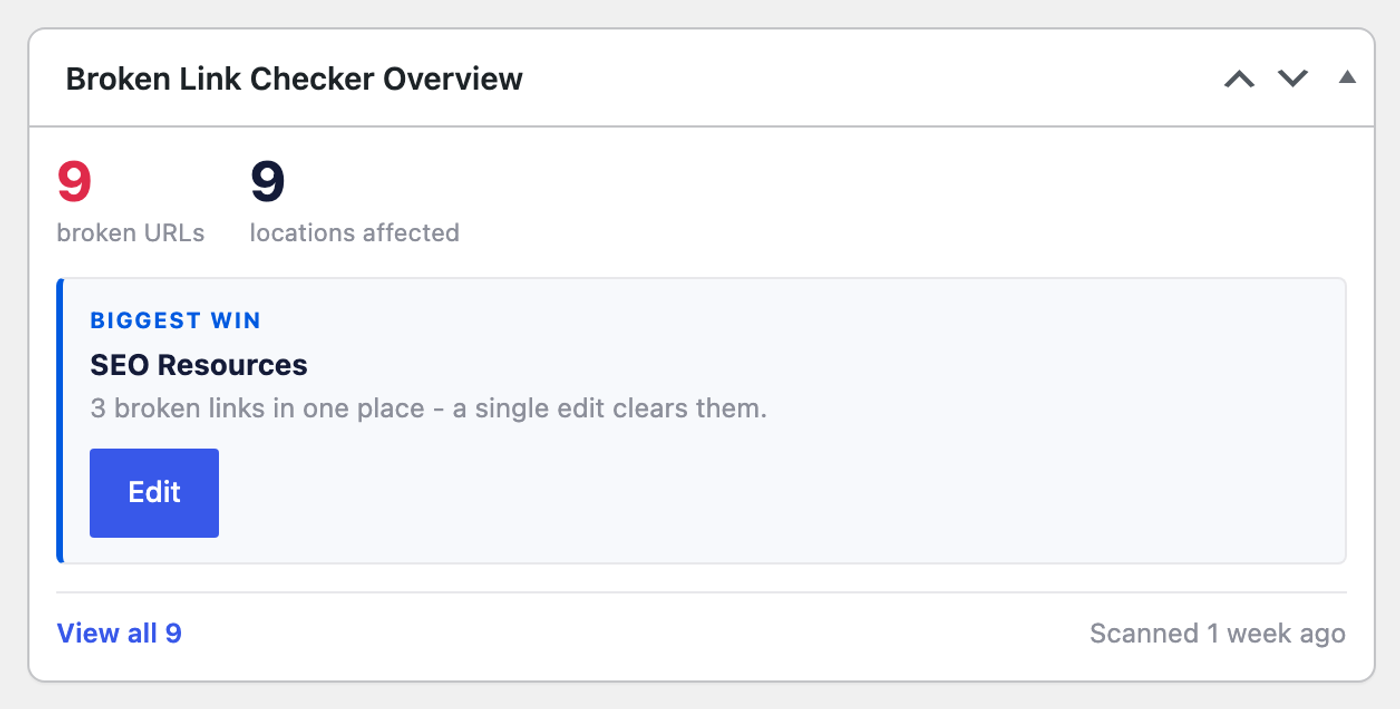
Broken Link Checker also adds a Broken Link Checker Overview widget to your WordPress dashboard. It shows your broken link count and your biggest win, which is the one fix that clears the most broken links. The button below it, such as Edit, takes you straight to that fix.
If you use All in One SEO, check the AIOSEO Details column on your Posts and Pages screens. It shows a broken link icon for any post with broken links. Hover over the icon and click View broken links to see that post’s links in the report.

That’s it! You now know how to find and fix broken links and images with Broken Link Checker.
Further Reading / Next Steps
To learn more about why broken links matter, read our guide on how to find and fix broken links in WordPress.
Frequently Asked Questions
Below, we’ve answered some of the most common questions about Broken Link Checker:
Do I need an account to use Broken Link Checker?
Yes. Broken Link Checker finds the links on your site without an account. It needs a connected free or paid account to check them.
See Connecting Your Account above.
Does Broken Link Checker check links to other sites?
Yes. Broken Link Checker checks links to your own site and to other sites on every plan, including the free plan.
What happens when I reach my link quota?
Broken Link Checker pauses link checking until your quota resets. A notice in the report warns you when you’re close to the limit. To keep checking, you can upgrade to a paid plan.
To see how many links you’ve used this month, look at the counter at the top right of the Broken Links Report.
If your site has more links than your quota, Broken Link Checker checks links up to your quota. A notice in the report tells you when this happens.
Does unlinking remove the text from my content?
No. Unlink removes only the link. The words stay in your content.
Can my visitors see the red underlines?
No. Only logged-in users who can edit the post see the highlights.
See Highlighting Broken Links on Your Site above.
How do I fix a broken link in my page builder?
Broken Link Checker finds links in Elementor, Divi, WPBakery, SiteOrigin, Avada, and SeedProd content. To fix one, edit the link in your page builder.