
Healthcare SEO helps medical practices, clinics, and healthcare organizations appear in search results when patients search online for health information or services. And those searches can be incredibly specific. So, if your website isn't visible at those moments, another provider probably is.
But healthcare SEO comes with an additional challenge: trust.
Health-related content can influence decisions about a person's well-being, which means accuracy, expertise, and transparency matter enormously. This is why your website needs to demonstrate authority, provide reliable information, and make it easy for search engines to understand your services and credentials.
In this guide, I'll explain how healthcare SEO works and the strategies you can use to improve search visibility. I'll also discuss how AIOSEO helps with local optimization and schema markup to author signals and on-page SEO.
Let's start with a quick definition.
In This Article
- What Is Healthcare SEO?
- Healthcare SEO and Keyword Research
- How AIOSEO Helps With Healthcare SEO
- Local SEO for Healthcare Practices
- Technical SEO Fundamentals for Healthcare Websites
- 4 Best Practices to Build Authority for Your Healthcare Website
- How to Measure Healthcare SEO Performance
- Healthcare SEO: FAQs
- Next Steps
What Is Healthcare SEO?
Healthcare SEO is the process of optimizing a healthcare website to improve its visibility in organic and local search results. The goal is to help the right patients find your services and information when they're actively searching.
For example, a dental practice may want to appear for “emergency dentist near me,” while a physiotherapy clinic might target searches such as “sports physiotherapist in New York”
Healthcare SEO can also extend beyond service-based searches. Hospitals, clinics, pharmacies, and health publishers often create educational content answering questions people have about conditions, treatments, medications, and general health.
A complete healthcare SEO strategy brings together several areas, including local SEO, on-page optimization, technical SEO, content creation, reputation signals, and structured data.
However, there's an important difference between healthcare SEO and SEO in many other industries: the consequences of inaccurate information can be much greater.
Health topics often fall into Google's Your Money or Your Life (YMYL) category because inaccurate information could potentially affect someone's health or safety. This makes signals associated with E-E-A-T (Experience, Expertise, Authoritativeness, and Trustworthiness) particularly important.
Good healthcare SEO ultimately has 2 jobs: help patients find you and give them enough reason to trust what they find.
What YMYL Means for Medical Websites
Now, as I mentioned above, YMYL stands for “Your Money or Your Life.” It's a category Google's quality rater guidelines use to describe pages that could affect someone's health, financial stability, or safety if the information is wrong or misleading.
Medical content is the textbook example of YMYL. A bad recommendation about back pain treatment or medication timing carries real consequences, so Google's systems and the human raters who help train them evaluate this content far more carefully than they would a blog about hobbies or travel. What this actually means for your website is that thin, generic, or unattributed health content struggles to rank, even if the target keyword has low competition on paper.
Here's a simple way to think about it: Imagine two nearly identical pages about managing seasonal allergies. One is unsigned and generic and could have been copied from a dozen other sites. The other names a nurse practitioner as the author, includes her credentials, and links to her provider profile on the practice's about page. Content-wise, they might say almost the same things. But Google has far more reason to trust the second page, and so does a patient reading it, because there's an accountable, checkable person behind it.
The practical upside is that this same caution protects you from much of the low-effort competition. Plenty of clinics still publish thin, unattributed pages, which means the practices that do this correctly stand out by comparison rather than having to out-write every competitor from scratch.
E-E-A-T and Why Google Checks Your Credentials
E-E-A-T stands for Experience, Expertise, Authoritativeness, and Trustworthiness. It's the framework Google's quality raters use to judge whether content comes from a credible source, and for YMYL topics like healthcare, it's not a nice-to-have. It's closer to a prerequisite.
For a medical practice, E-E-A-T shows up in specific, checkable signals:
- Does the page have a named author with visible credentials?
- Does the practice have a real, detailed “About” page, not just a stock photo and a paragraph?
- Do other reputable medical sources, directories, or news outlets link to or reference the practice?
- Is the content written by, or reviewed by, someone qualified to speak on the topic?
- Does the practice have a consistent, verifiable presence across the web, from its Google Business Profile to its directory listings?
Here's the good news for a solo practitioner or small clinic: a one-person practice with a clear bio, listed credentials, and a well-built about page already has an edge over an anonymous blog with no attribution. And I'll come back to exactly how to build this out in the E-E-A-T section below, including how AIOSEO's Author SEO feature automates the schema markup that communicates this to Google.
Healthcare SEO and Keyword Research
Once you understand the rules you're playing by, the next step is figuring out what your patients are actually typing into Google. This is where good keyword research plays a major role in medical SEO.
How Patients Actually Search
Patients search in 3 different ways, and each one tells something different about their search intent.
Symptom searches look like “chest pain when walking” or “why does my knee hurt when going upstairs?” These are top-of-funnel, informational, and dominated by huge sites like WebMD, Mayo Clinic, and Healthline. It might be difficult to outrank them for broad symptom terms, especially if you're a relatively newer website.
Condition searches look like “COPD treatment” or “pediatric asthma management.” These are more specific but still largely owned by major health publishers.
Provider and service searches look like “cardiologist near me” or “urgent care [my city].” This is where I'd suggest you start. Focus on local intent and service-specific terms where you're competing against other local practices.
A simple way to build your keyword list is to start typing your core services into Google's search bar, see what autocomplete suggests, then scroll to the “People also ask” box on the results page for each one.
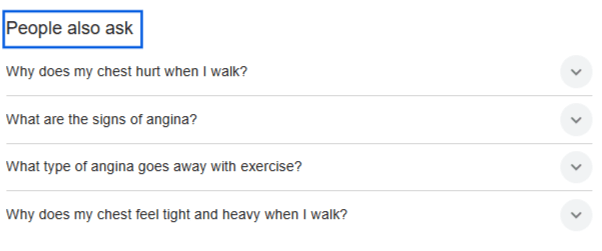
Both surface the exact phrasing real patients use, which is often different from the clinical terminology. If your Google Business Profile is active, its search terms insights also show the actual queries people typed before finding your listing, which is some of the most reliable, zero-cost keyword data you can access.
Keyword Types for Clinics and Practices
Breaking this down further, there are 4 content types worth building pages around, and I'd suggest you have at least one page mapped to each relevant combination of service and location.
- Service Pages: Target terms like “physical therapy for back pain [city].” These describe a specific thing you offer, in a specific place, and they're usually the pages that convert best because the searcher already knows what they need.
- Condition Pages: Target terms like “pediatric asthma treatment [city].” These describe a specific problem you treat, again tied to the location where relevant, and they tend to serve patients slightly earlier in their decision process than a service page does.
- Provider Pages: Target terms like “Dr. [Name] [specialty].” Patients frequently search for a specific doctor by name, especially after a referral from another provider or a recommendation from a friend.
- FAQ and Informational Content: Targets question-based searches like “how long does a sports injury take to heal?” This content supports your service and condition pages and builds topical depth.
I wouldn't worry too much if the exact-match search volume on a hyper-local term looks tiny in a keyword tool. Low volume and low value aren't the same thing in local healthcare search.
In fact, I'd advise targeting question-based keywords more, as they deserve extra attention. A large share of healthcare searches trigger an AI-generated overview above the standard results, and those summaries tend to pull from pages that answer a specific question clearly and early, rather than pages that bury the answer three paragraphs into a long, unstructured wall of text.
Once you've completed your keyword research and moved towards content optimization, you'll need an SEO plugin to set this up for your medical SEO.
And this is where AIOSEO comes in.
How AIOSEO Helps With Healthcare SEO
As I said, healthcare SEO requires more than optimizing a page for a keyword. Search engines need clear information about your healthcare organization, its locations, the people creating or reviewing your content, and the subject of each page.
For a healthcare website, I'd pay particular attention to 3 AIOSEO features: Local SEO, Author SEO, and TruSEO.
1. Strengthen Local Healthcare SEO With AIOSEO Local SEO
Local visibility is especially important for healthcare providers because many patient searches have immediate local intent.
AIOSEO's Local SEO feature helps you provide search engines with structured information about your business, including your address, contact details, opening hours, and location.
To set it up, activate Local SEO and configure your practice's business information inside AIOSEO. You can then display information such as opening hours, maps, and business details on your WordPress site.

If you operate several clinics or practices, AIOSEO also supports Multiple Locations. This allows you to create and optimize individual locations.
2. Demonstrate Expertise With Author SEO
Author information becomes particularly important when you're publishing health content.
If an article discusses a condition, treatment, medication, or other health topic, readers should be able to determine who created or reviewed that information and what qualifies them to do so.
AIOSEO's Author SEO feature lets you add detailed information about content authors inside WordPress.
After activating Author SEO, each author's WordPress profile gets additional Author SEO fields.
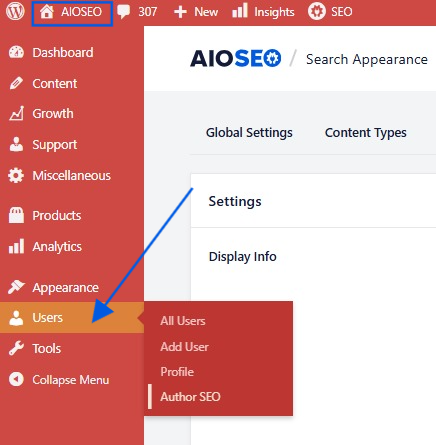
You can use these to add information such as their:
- Employer
- Job title
- Areas of expertise
- Awards
- Author biography
- Relevant social profiles
AIOSEO then outputs relevant structured data about the author. For healthcare content, this gives you a useful way to make genuine provider expertise clearer to search engines.
For example, if an article about heart health is written by a qualified cardiologist, their profile can clearly identify their job title, employer, relevant expertise, and professional background rather than leaving Google with nothing more than a name in a byline.
AIOSEO also provides Reviewer functionality, which can be useful when your editorial process involves having healthcare content reviewed by an appropriate professional.
The important principle is that Author SEO should represent real credentials, not create the appearance of expertise. Any qualifications or areas of expertise you add should be accurate and verifiable.
3. Optimize Individual Pages With TruSEO
Once you've established the organization and author signals, use TruSEO to check the on-page optimization of individual healthcare pages.
Add your target term under Keywords, and TruSEO analyzes the page and provides actionable recommendations based on readability, headline health and keyword integration.
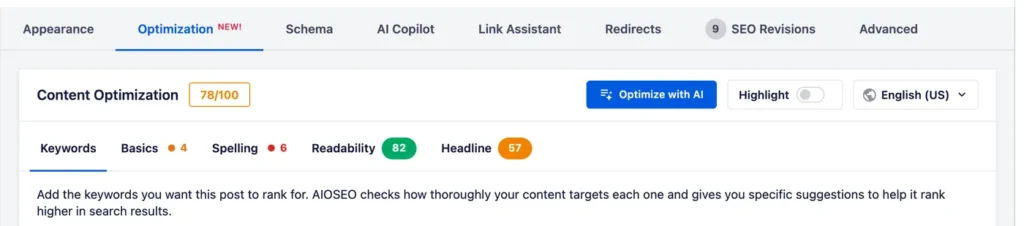
This is particularly helpful if a healthcare site has dozens or hundreds of service and educational pages. Instead of relying on memory to check every basic optimization, TruSEO gives writers and editors a consistent framework to work from.
However, there's an important distinction with healthcare content: an SEO score is not a medical accuracy score.
While TruSEO can help diagnose SEO issues, medical claims must still be accurate, appropriately sourced, and reviewed in accordance with your organization's editorial standards.
Local SEO for Healthcare Practices
Apart from content optimization, local SEO is one of the highest-leverage strategies you can pursue for most clinics. The local map pack, the three results Google shows above the standard organic listings, captures a large share of clicks for “near me” and city-based searches before a searcher ever scrolls to organic results.
Here's how you can set your medical business up for local success.
Set Up and Optimize Your Google Business Profile
Your Google Business Profile, or GBP, is the foundation of local visibility. If you haven't claimed and verified it yet, that's step one, done directly through Google, and it's worth doing before anything else in this section since several other tactics depend on having a verified listing.
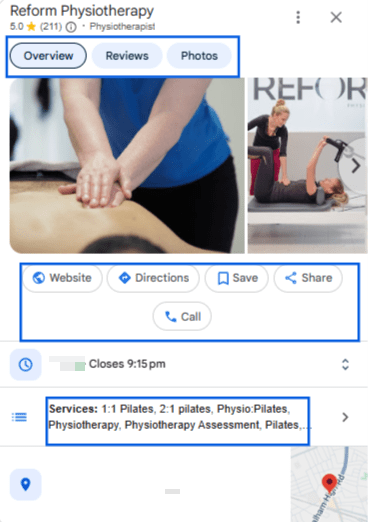
Once it's claimed, fill out every section completely rather than leaving the defaults in place. Choose the most specific primary category available. “Urgent Care Center” beats “Medical Clinic.” “Pediatrician” beats “Doctor.” A specific category helps Google match your listing to specific searches, while a vague one leaves you competing in a broad category.
From there, add each service you offer as its own listed service, your operational hours, including holiday hours, and current photos of your location, exam rooms, and team. I'd also suggest keeping the Q&A section active, answering questions before a stranger posts an inaccurate answer that stays visible to every future visitor.
Also, use the Posts feature to share updates, such as a new provider joining the practice or a seasonal service, since active profiles tend to earn more trust signals than those that have sat untouched since the day they were verified.
Lastly, make sure you get actual reviews as they matter more here than in almost any other industry. I'd suggest asking your patients to leave a review after a positive visit. But remember that Google's guidelines prohibit incentivized reviews, and for medical providers specifically, such exchanges raise separate professional and ethical concerns about soliciting favorable feedback.
NAP Consistency
NAP stands for Name, Address, and Phone number, and it must be identical everywhere your practice appears online. This means your website, Google Business Profile, and every directory listing you're part of, down to formatting details like whether you write “St.” or “Street” and whether you include a suite number consistently.
This may sound like a small detail, but it's not, because these small inconsistencies dilute the local authority Google assigns to your practice. Google cross-references these listings to confirm your business is real and located where you say it is, and mismatched information makes that confirmation less certain, which can quietly suppress how often you show up in local results.
Healthcare has its own layer of directories worth checking beyond the general ones, so go through each one, confirm your NAP data, and update anything that's outdated, including old addresses left over from a previous location.
Add Local Business Schema to Your Website
Schema markup is structured data you can add to your website's code that tells search engines exactly who you are, where you're located, and what you do, in a format they can read directly rather than having to infer from page text. This is part of what makes rich results possible, like a map card or a knowledge panel showing my hours and phone number right in the search results.
In AIOSEO, this lives under the Local SEO settings or under the AIOSEO settings for individual pages. You can enter your business name, address, phone number, and a logo or representative image, connect my location via the Google Maps integration, and set your opening hours in a structured, search-engine-friendly format.
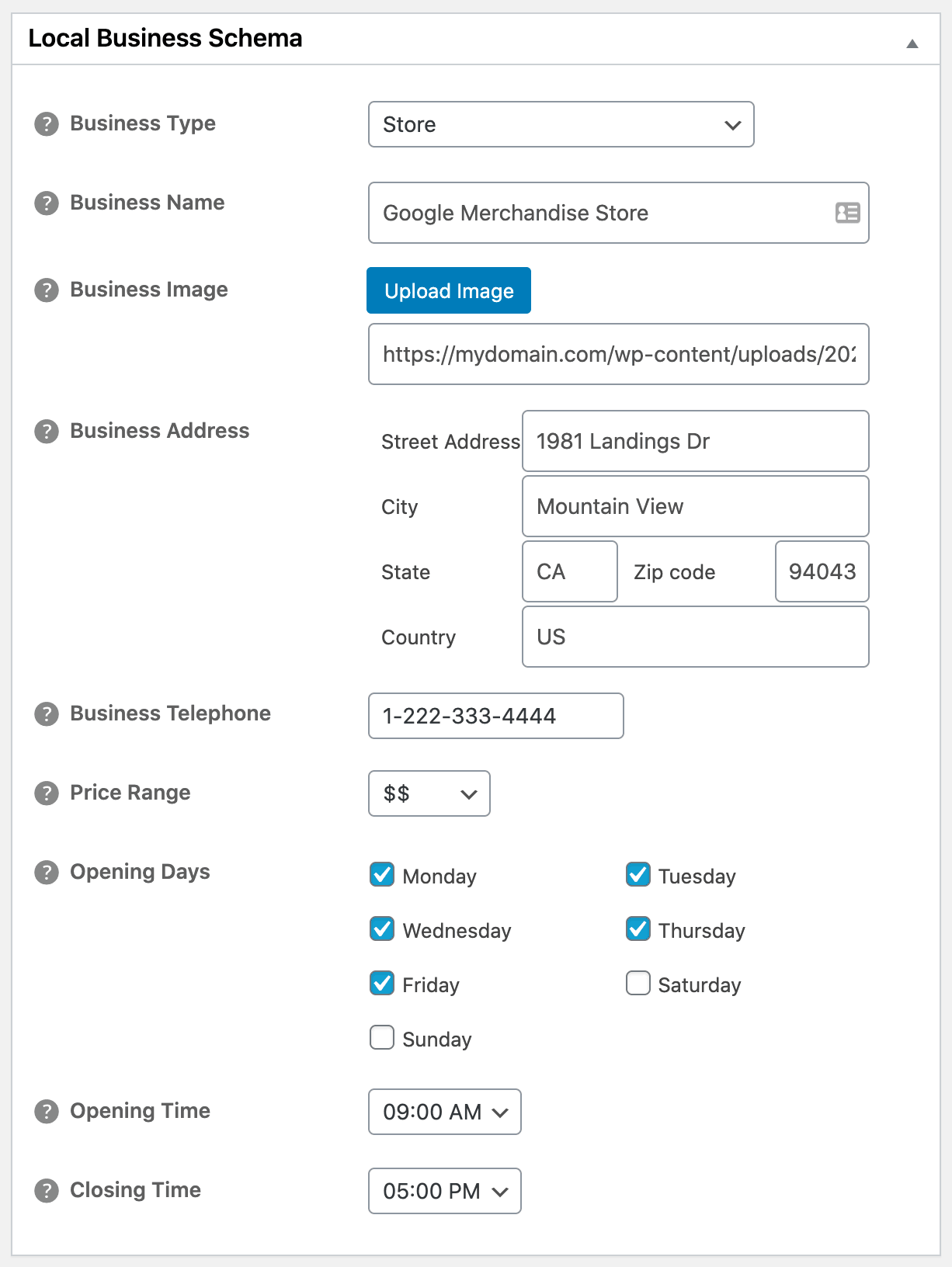
AIOSEO handles the technical output automatically once I've filled in the fields, generating the underlying schema code.
For a deeper technical walkthrough of the schema fields themselves, AIOSEO's Local Business SEO documentation covers single-location setup in more detail.
Optimize for Multiple Clinic Locations
If you run more than one location, each one needs its own dedicated page on your website, not just a separate Google Business Profile. A shared “Locations” page listing three addresses in a table doesn't give Google enough context to associate each address with its own local relevance, and it gives patients almost nothing to go on, either.
Include the specific providers who work at that location, any services unique to that site, directions and parking notes specific to that address, and, where available, patient testimonials from that location. This also helps you avoid duplicate content.
The best part is that AIOSEO's multi-location support lets you manage each location's schema, hours, and map from a single dashboard. Each location gets its own business information, structured hours, and map placement.
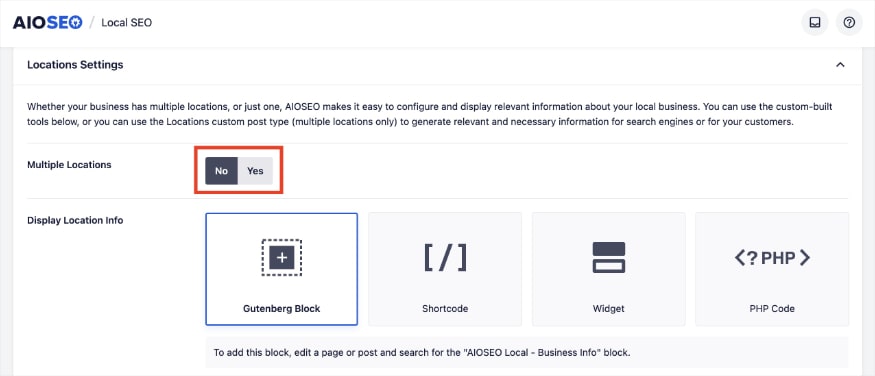
Make sure you select the multiple locations option so you can manage your website accordingly.
Technical SEO Fundamentals for Healthcare Websites
None of the content and local SEO work I've discussed above would make a bigger impact if your website is slow, has technical issues, or cannot be crawled properly. This is why it's important to work out technical SEO for healthcare and medical websites.
Mobile Optimization
Most “near me” healthcare searches happen on a phone, often from someone who wants a fast and quick answer. A slow, non-responsive site loses that patient before they've read a single word, and they'll bounce straight back to the search results and click a competitor instead.
Pay attention to Core Web Vitals here: how fast the page loads, how quickly it responds to a tap or click, and whether elements shift around while the page is still loading.
I'd also advise compressing images, avoiding intrusive interstitial popups, and keeping the header and navigation lightweight, all of which help build a better user experience.
HTTPS and Site Security
HTTPS is a baseline trust signal for any website, but it matters even more for healthcare sites, where patients may be submitting personal information via a contact form, an appointment request, or an intake form.
An insecure connection here isn't just a minor technical flaw; it can make a patient distrust the entire practice before they've even called. In fact, most browsers now actively flag a non-HTTPS site as “not secure” in the address bar, which isn't the first impression you want to make.
XML Sitemaps
An XML sitemap is a file that lists every important page on your site so search engines can find and crawl them efficiently. This matters even more as your site grows to include individual pages for every service, condition, provider, and location. Without one, a newly published page might sit undiscovered for weeks because nothing has yet pointed a crawler to it.
AIOSEO generates this sitemap automatically, updating it as you add new pages, so you don't have to maintain it by hand or worry about a new service page going unnoticed by Google.
4 Best Practices to Build Authority for Your Healthcare Website
Once the on-site fundamentals are in place, the next step is to build website authority.
1. Create Dedicated Service Pages
Every service you offer should ideally get its own page. That's because lumping services together dilutes each service's relevance to its own keyword and makes the page harder for a patient to skim when they're only interested in a specific service.
Each service page needs a few non-negotiable elements:
- Target keyword in the page title and in the H1 so both search engines and skimming readers immediately understand what the page covers.
- A location in the title if you serve a specific area.
- A clear call to action, whether that's booking an appointment, calling the office, or filling out a contact form.
I'd also advise linking related service and condition pages wherever it makes sense. This internal linking helps patients find related services and helps Google understand how the pages on your site relate to each other and to your practice as a whole.
2. Write Medical Content That Builds Trust
The content itself matters as much as the technical setup, and healthcare content has its own rules about what belongs on the page and what doesn't. Keep everything factual and accurate, and avoid giving specific medical advice.
There's a real difference between explaining what a condition is in general terms and telling a reader what to do about their own specific case. Your content needs to stay firmly on the explaining side of that line. I'd suggest writing in plain language, because your patients aren't doctors, and content written the way you'd write it for another clinician doesn't serve the person deciding whether to book an appointment.
A useful structure for a service or condition page covers:
- What the condition or service is,
- Who it's for,
- What the treatment or visit involves,
- When someone should seek care.
You should also avoid mentioning any specific dosage recommendations, diagnostic statements that tell a reader what they have, and anything that starts to cross from informing into practicing medicine on the page.
Also, make sure that every informational page gets a clear author attribution, a named provider, or a credentialed staff member.
3. Get Listed in Medical Directories
Healthcare-specific directories function as authoritative citations that signal legitimacy to both patients and search engines. Healthgrades, Zocdoc, WebMD's Doctor Finder, Vitals, and US News Health are the major ones worth prioritizing.
Make sure your listing exists on each, that it's claimed where possible, and that the NAP data matches your website exactly to ensure consistency across all platforms.
I'd also advise treating these listings as living pages, not a one-time setup task, and going back periodically to keep photos, hours, and service lists up to date.
4. Earn Backlinks from Local and Medical Sources
Backlinks from relevant, reputable sources can help you earn domain authority on search engines. Target local hospital affiliations, medical association memberships, local chamber of commerce, and local health journalism outlets.
You can also offer yourself as a source for journalist queries, similar to HARO-style requests, where reporters looking for a quote from a credentialed provider on a health topic are actively searching for exactly what you can offer and often can't find locally.
Partnerships with other local businesses that see the same patient types you do are worth pursuing as well. For instance, a physical therapy practice and a local gym, or a pediatric clinic, aren't necessarily competitors, but a simple resource link or joint blog post between the two can produce a natural, relevant backlink for both.
How to Measure Healthcare SEO Performance
SEO in healthcare tends to move more slowly than in other industries, partly because YMYL content receives extra scrutiny and partly because trust signals like backlinks and directory listings take time to accumulate. That's normal, and it doesn't mean the work isn't paying off.
So, in the meantime, you can focus on these metrics to measure success:
- Organic traffic, tracked individually. It will also inform you if specific pages are actually working and which need more attention or a content refresh.
- Google Business Profile impressions and calls that are visible directly in your GBP dashboard.
- Keyword rankings, specifically for your service-plus-location terms. You can easily track these in Google Search Console.
- Appointment form conversions, or call volume, if that's how patients reach you.
You can track these weekly or monthly. Establish the cadence as needed.
Healthcare SEO: FAQs
What is healthcare SEO?
Healthcare SEO is the practice of optimizing a medical practice's website to rank in search results for the services, conditions, and locations it serves. It follows the same core principles as general SEO, keywords, on-page optimization, local listings, and backlinks, but adds extra weight on credentials, author attribution, and content accuracy because Google treats medical content as YMYL.
How is medical SEO different from regular SEO?
Medical SEO sets a higher bar for trust and accuracy because Google classifies health content as YMYL, which could affect a person's health or safety decisions. That translates into a stronger emphasis on E-E-A-T signals, such as named, credentialed authors, accurate and well-sourced content, and a clean, verifiable business presence, on top of the standard technical and on-page SEO work every website needs.
How do I do local SEO for a medical practice?
Start with a fully completed Google Business Profile using the most specific category available, keep your name, address, and phone number identical across your website, GBP, and every directory listing, and add Local Business schema markup to your website so search engines can confirm your business details. If you have more than one location, give each one its own dedicated page rather than listing them all on a single page.
What is YMYL in healthcare SEO?
YMYL stands for Your Money or Your Life, a category in Google's quality rater guidelines for content that could impact someone's health, financial stability, or safety. Medical content is a core YMYL category, which means Google evaluates it more carefully for accuracy and credibility than it does most other topics, making things like author credentials and content sourcing more important for ranking.
How long does SEO take for a healthcare website?
Healthcare SEO typically moves more slowly than other industries because of the added scrutiny of YMYL content and the time it takes to build the trust signals E-E-A-T depends on, such as directory listings, backlinks, and a track record of consistent, credentialed content. Most practices should expect to see meaningful movement over several months of consistent work rather than weeks, particularly for competitive local terms.
Next Steps
Healthcare SEO isn't an area where I'd recommend chasing quick wins.
Start with trust and building authority. From there, strengthen your local presence, build useful service pages, publish medically accurate content that answers the questions your audience is genuinely asking, and ensure your technical SEO supports everything you've created. AIOSEO can help bring those pieces together in WordPress.
But the most important principle remains the same: optimize trustworthy healthcare content rather than creating healthcare content purely to optimize it.
Do that consistently, and you'll be building a website designed not only to earn more search visibility but also to deserve the trust of the patients who find it.
Disclosure: Our content is reader-supported. This means if you click on some of our links, then we may earn a commission. We only recommend products that we believe will add value to our readers.
Want to Try AIOSEO for Free?
Enter the URL of your WordPress website to install AIOSEO Lite.