
Wondering if a small law firm can really compete with the big names in your city on Google? It can, and you don't even need a massive marketing budget to make that happen. You only need law firm SEO.
Whether someone is looking for a personal injury attorney, divorce lawyer, or estate planning specialist, appearing at the top of local search results through law firm SEO can be the difference between winning a new client and losing them to a competitor.
The legal industry is one of the most competitive markets in SEO. That's because you're not only competing against other firms in your city but also legal directories and national publications that often dominate search results. That's why modern law firm SEO goes beyond keywords and backlinks.
So, in this guide, I'll walk you through the law firm SEO strategies I've found most effective for improving local visibility.
Let's start with a quick definition.
In This Article
What is Law Firm SEO?
Law firm SEO is the process of optimizing a law firm's website to rank higher in search engine results when potential clients search for legal services online.
For example, if someone searches for terms like “personal injury lawyer near me,” “family lawyer in Dallas,” or “estate planning attorney,” effective law firm SEO helps you appear in those search results. The higher your visibility, the more likely prospective clients are to visit your website, contact your office, and ultimately hire your firm.
Because attorney SEO is quite a competitive niche, it combines several elements that work together to improve your visibility and build trust with both search engines and potential clients. These include things like local SEO, helpful content, technical SEO, E-E-A-T signals, and structured data. Together, these elements help Google determine whether your firm is a relevant and trustworthy result for someone seeking legal assistance.
If you're just getting started, check out this complete guide to local SEO to learn the fundamentals.
The goal is to attract qualified clients who are actively looking for the legal services your firm provides. A well-executed law firm SEO strategy drives consistent, high-intent traffic, reduces your reliance on paid advertising, and creates a sustainable long-term source of leads.
The Competition Level in Legal Search
Here's the thing: legal search terms are some of the most competitive in local search, and it's not close. Someone searching for “personal injury attorney” or “divorce lawyer” is often ready to hire someone that same week, which makes every click worth fighting for. Advertisers know this, too, which is part of why legal keywords are consistently among the most expensive in Google Ads.
That competition shows up in the organic results as well. National firms and legal directories often dominate the broad, 1 or 2 word searches, the ones with the biggest search volume. That's because they've been building domain authority for years, and a brand-new firm website has almost no chance of outranking them for common search terms.
So, small and solo firms rarely win on those broad terms, and honestly, they don't need to. The real opportunity is hyperlocal. Phrases like “personal injury attorney in [city]” or “[city] divorce lawyer” attract a fraction of the competition and are a much better match for what the searcher actually wants: a lawyer near them.
This is also where the Local Pack comes in, the 3 map results Google shows above the regular organic listings for local searches.
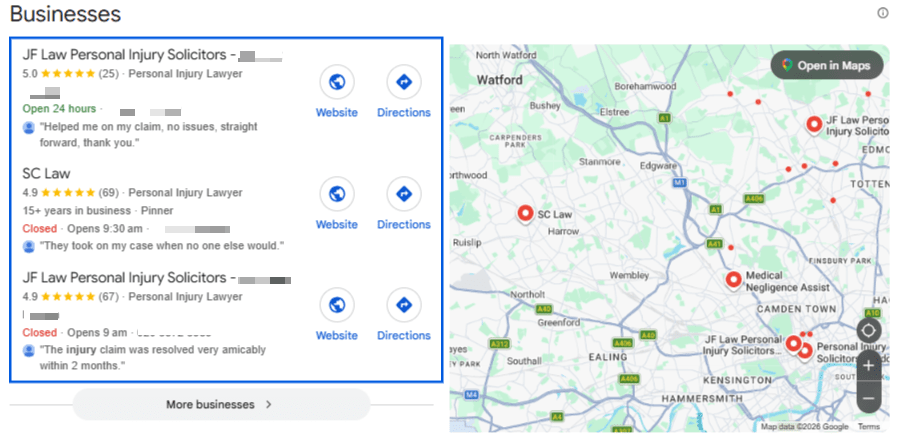
The Local Pack rewards proximity, review volume, and a complete Google Business Profile over marketing budget, which levels the playing field in a way organic rankings alone don't. A solo attorney with a well-managed and optimized Google Business Profile can outrank a national firm's branch office in the Local Pack for a hyperlocal search.
Bar Advertising Rules and SEO Content
Most state bar associations have rules about what law firms can say in their marketing, and that includes your website. Common restrictions cover client testimonials, outcome guarantees, and superlative claims about being the best firm in town. These rules exist to protect the public from misleading advertising, and they apply just as much to a blog post as they do to a billboard.
As a law firm, ensure all website content complies with its state bar advertising rules. Avoid making unverifiable claims. Any credentials, awards, testimonials, or case results included in your content or schema should accurately reflect information that's visible on the page and permitted under your jurisdiction's advertising guidelines.
Here's the good news: none of this affects the SEO fundamentals we're covering in this guide. Structuring your pages well, setting up local business schema, and building out your Google Business Profile don't run afoul of bar advertising rules, since all of that is about how search engines understand your site, not the claims you're making to readers.
Where it does matter is the actual words you choose when you write your content. Before you publish anything new, take a few minutes to check your state bar's advertising guidelines, since the specifics vary by state and change from time to time. I won't try to summarize any particular state's rules here, since they shift, but a quick search for your state bar's advertising guidelines for attorney websites will point you to current guidance. Think of it as a compliance check that happens after you've written strong content, not a reason to avoid writing content in the first place.
If you'd like to evaluate how your website is performing before making any changes, use AIOSEO's SEO Audit Checklist to identify opportunities to improve your rankings.
How Clients Search for Law Firms
It's easy to assume potential clients think the way SEO professionals do, in keywords and search volume, but they're usually just trying to solve a stressful problem as quickly as possible. Keeping that difference in mind changes how you prioritize your pages.
Use Local Intent Keywords
Do you know that 72% of people researching an attorney still turn to Google, and 42% now also check an AI tool like ChatGPT during that process?
That's a meaningful jump from previous years, and it tells us something important: showing up well in Google's local results matters just as much as it ever did, since AI tools lean heavily on the same underlying signals, your Google Business Profile, your schema, and your on-page content, when they decide who to recommend.
Someone who has already decided they need a lawyer and is ready to hire is what I'd call a high-intent visitor. These searches don't happen as often as broader, informational ones, but each one is worth far more to your firm.
A person searching for how long they have to file a personal injury claim in their state is doing research. A person searching “personal injury attorney [city]” is often ready to pick up the phone. This is why local terms deserve your attention even when the search volume numbers look small on paper, because the people behind those searches convert at a much higher rate.
Keyword Research for Law Firms
You don't need expensive keyword research tools to find the right keywords for your firm. Here's a simple process that works well for most small and solo practices:
- List every practice area you handle. Be specific, family law and estate planning are 2 different practice areas, not 1.
- Pair each practice area with your city, county, and any nearby towns you serve. If you practice family law in 1 city but also take clients from 2 neighboring towns, those are separate keyword combinations worth considering.
- Type each phrase into Google and check the autocomplete suggestions for variations. This shows you the exact language real people are typing, which is often different from the legal terminology you'd use yourself.
- Prioritize the phrases where your local competitors appear in the results, not just in national directories.
Each practice area deserves its own dedicated page, not a single page that tries to cover everything you offer. This matters more than most attorneys expect. A single “Practice Areas” page that briefly mentions 8 different services can't compete with a dedicated, in-depth page built around 1 specific keyword, because it doesn't give Google, or the reader, enough depth on any single topic to feel authoritative.
As you write each page, use AIOSEO's TruSEO Analysis to score your content in real time, checking whether you've used your target keyword often enough, whether your headings are structured well, and whether your content length matches what's typically needed to rank.
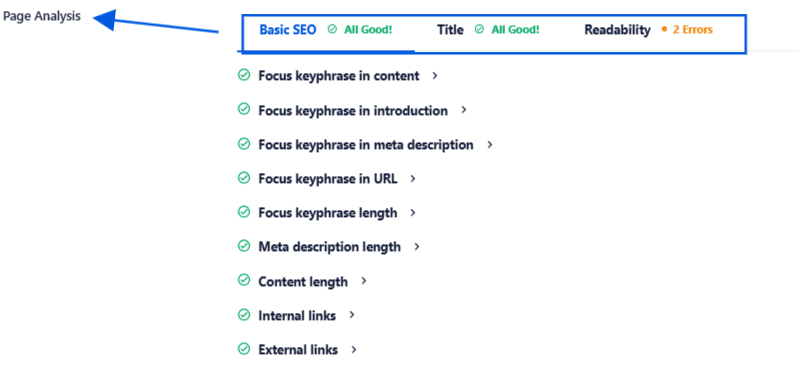
It's great for catching the kind of on-page gaps that are easy to miss when you're focused on the legal substance of what you're writing.
How to Improve Law Firm SEO Using AIOSEO
Now that you've understood that legal SEO is built on trust. And what that means is that before Google or search engines recommend your firm to potential clients, it needs to understand who you are, where you practice, and why you're qualified to provide legal services.
This is where AIOSEO helps communicate those signals clearly through structured data, local SEO features, and detailed author information. Here's how you can use these features to boost your law firm's SEO.
Local SEO for Law Firms
The Local Pack, the map results at the top of Google for local searches, is the main battleground for law firm search. Unlike organic rankings, where age and backlinks carry significant weight, the Local Pack is driven by a smaller, more manageable set of factors.
It comes down to 4 things:
- A complete and active Google Business Profile
- Consistent NAP information across the web
- The schema markup on your website
- How well you manage things if you have more than 1 office.
The good news, especially for smaller firms, is that none of these requires a developer or an agency. However, they do require some patience, since local rankings tend to build gradually rather than jump overnight.
And the great news is that AIOSEO's Local SEO feature helps optimize your firm for these searches by allowing you to add important business information directly into structured data, including:
- Firm name
- Office address
- Phone number
- Opening hours
- Service areas
- Google Maps integration
If your practice has offices in multiple cities, AIOSEO also supports multi-location SEO, making it much easier to manage location pages while providing Google with consistent location signals.
AIOSEO's Local SEO feature, available on the Plus plan and above, handles this without touching a line of code. Head to All in One SEO » Local SEO » Business Info, and you'll fill in your Name, Address, Phone number, Hours, and Map. You can easily add all this information from the dashboard.

This helps search engines better understand your offerings without requiring you to manually write schema markup.
Set Up and Optimize Your Google Business Profile
Your Google Business Profile, formerly known as Google My Business, is arguably the single most important local SEO asset you have. It's free, it's what populates the Local Pack, and for a law firm, it's often the first thing a potential client sees before they ever visit your website.
Start here:
- Claim and verify your listing at business.google.com if you haven't already. Verification usually happens by mail, phone, or video, depending on your business type.
- Choose the most specific primary category available, like Personal Injury Attorney, Family Law Attorney, or Criminal Justice Attorney, instead of a generic “Lawyer” category. Google uses this category as one of the strongest signals for which searches your listing should show up in.
- Fill out every section completely: your services, hours, photos of your office and team if you're comfortable sharing them, your website link, and your phone number. An incomplete profile signals to Google and potential clients that the listing isn't actively maintained.
- Add each practice area as a listed service within your profile, not just somewhere in your business description.
- Respond to every review you get, good and bad. A thoughtful response to a negative review often does more for your credibility than a dozen 5-star reviews with no engagement from the firm.
One thing I'd add from experience: many firms set up their Google Business Profile once when they first open, and never touch it again. Remember to update it regularly. Update your hours around holidays, post updates when you add an attorney or a new practice area, and keep your photos up to date. After a matter closes, ask the client to share their experience on Google.
Google rewards profiles that show ongoing activity, not those filled out once and forgotten.
Make Sure Your NAP Must Match Everywhere
NAP stands for Name, Address, and Phone number. Your firm's NAP must be identical across all online appearances, including your website, Google Business Profile, and every legal directory listing. This may seem like a small detail, but it's one of the most common reasons local rankings stall.
Small inconsistencies, a suite number that shows up on your website but not on Avvo, “St.” instead of “Street,” or a phone number that's off by 1 digit somewhere, quietly weaken your local rankings. Google cross-references these listings to confirm you're a legitimate, established business, and mismatches make that verification harder. Individually, none of these looks like a big deal. Together, across a dozen directories, they can meaningfully hold back a firm that's otherwise doing everything right.
I'd advise you to check your listings in the directories that matter most to law firms, as well as your state bar's directory. Search your firm name on Google and see what comes up. Fix any mismatches you find, starting with the directories that show up highest in the results, since those carry the most weight. If your firm has changed its name, moved offices, or merged with another practice, this check becomes even more important.
Add Local Business Schema with AIOSEO
Schema markup is code you add to your site that tells search engines specific facts about your firm: your name, address, phone number, hours, and the area you serve. Visitors never see this code directly, but search engines read it to better understand your business than they can from your page content alone. It's what powers Google's local knowledge panel and can help your listing stand out in search results with extra detail.
Using the schema generator in AIOSEO, you can do it easily without coding. For the Type field, choose the option in the dropdown that best describes your firm. If a specific legal business type, like LegalService, isn't available as a preset option, LocalBusiness still provides search engines with the core details that drive your Local Pack visibility: name, address, phone number, hours, and service area.
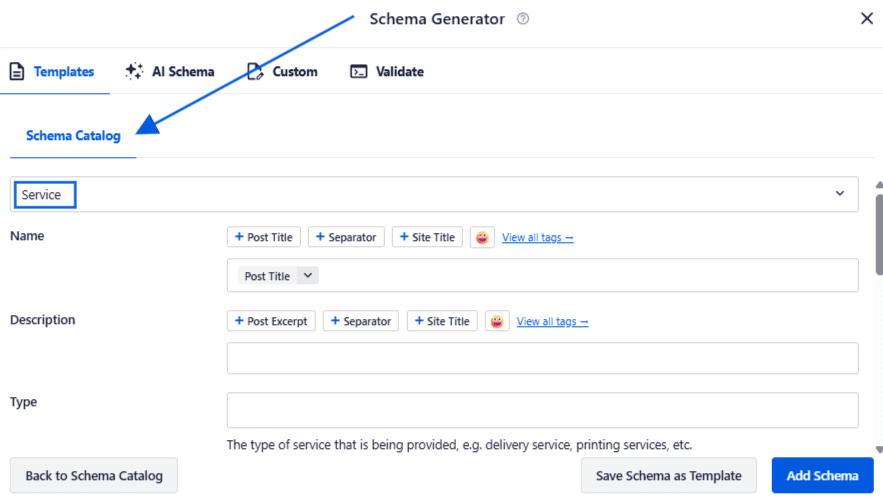
If you want a more specific legal schema type layered on top of that foundation, AIOSEO's Schema Generator lets you add custom schema types, including LegalService, without writing any code yourself. This isn't required to see results from local SEO, but it's a nice additional layer of specificity for firms that want to go further.
Manage Multiple Office Locations
If your firm has more than 1 office, each office needs its own dedicated page, not just a Google Business Profile listing. It's tempting to add a second office as a quick mention on your existing contact page, but that approach gives Google almost nothing to work with when someone searches for a firm in that second city.
Turn on Multiple Locations under All in One SEO » Local SEO, and AIOSEO creates a separate Locations post type where you can manage the schema, hours, and business details for each office from 1 dashboard, without needing to duplicate settings by hand for every location.
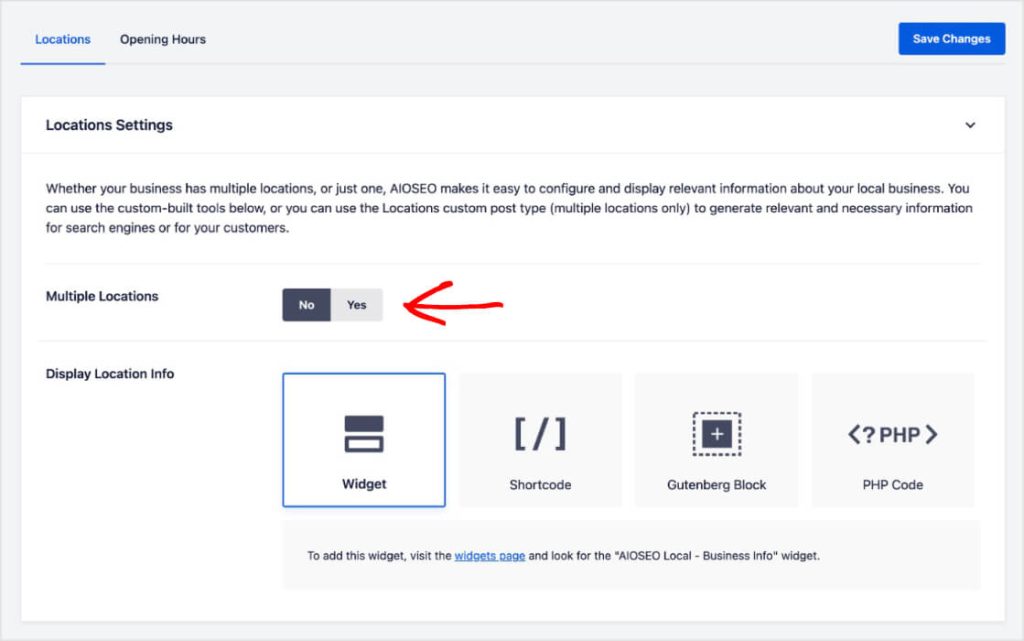
Give each location page its own local keyword target, like “[practice area] attorney in [city],” rather than letting 1 page try to rank for every city you serve. Each location page should also include unique content about that office: the attorneys based there, the specific practice areas handled at that location, and directions or parking information that's genuinely useful to someone planning a visit.
Duplicating the same paragraph across every location page with just the city name swapped out is a common shortcut, but it rarely performs well, since it gives Google very little reason to treat each page as genuinely distinct.
On-Page SEO for Law Firm Service Pages
Once your local signals are in place, the next step is ensuring each page on your site is built to rank and convert. So, here's how to do that.
Create Dedicated Practice Area Pages
Give each practice area its own page. Don't combine family law, estate planning, and elder law on a single page just because 1 attorney at your firm happens to handle all 3. Both Google and your visitors respond better to focused pages than to broad ones.
Each page should target 1 primary keyword, like “divorce attorney [city]” or “estate planning lawyer [city],” and should cover a consistent structure:
- Who you are and what you handle within this specific practice area
- How the process typically works, from the first consultation through resolution
- Who this page is for, since a personal injury page written for a car accident client reads differently than one written for a workplace injury client
- A clear call to action inviting the reader to contact your firm
This structure gives search engines a clear, complete page to associate with your target keyword, and it gives a stressed, first-time visitor exactly the information they're looking for without making them dig for it.
Optimize Titles, H1, and Meta Descriptions
On each practice area page, scroll down to the AIOSEO settings box below the content editor to set your SEO title and meta description.
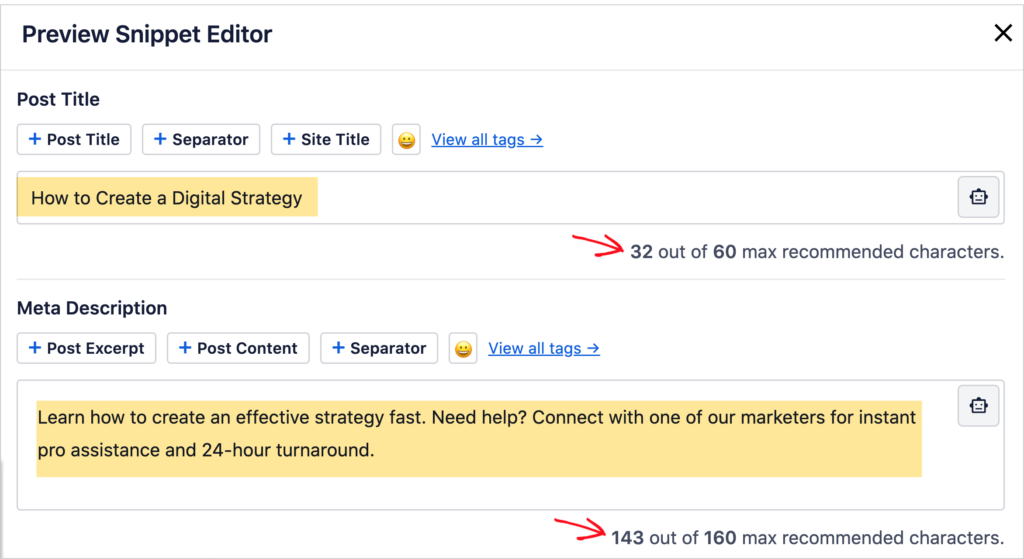
These fields control exactly what shows up in Google's search results, and they matter more than a lot of attorneys realize, since a well-written title and description can be the difference between a click and a scroll past your listing.
For the meta description, state what you do, who you serve, and 1 credibility signal, like years of experience or a specific certification, written as a short pitch rather than a list of features. Something like: experienced practice area attorney serving your city for over 15 years, with a free consultation available.
The best part is that AIOSEO shows you a live preview of how your title and description will look in Google's results as you type, along with a character counter so you know exactly when you're approaching the cutoff. It's one of my favorite features, as it saves a lot of guesswork compared to writing titles blindly and hoping they display correctly.
Write Content That Earns Trust and Ranks
Someone landing on a law firm page is often stressed, sometimes scared, and needs to know quickly that you understand their situation. I like to structure each page around what the practice area covers, common situations you handle, the process from start to finish, and a short set of frequently asked questions at the end.
Write in plain language wherever you can. Someone dealing with a divorce or a personal injury claim for the first time doesn't know legal terminology, and jargon makes your firm feel harder to work with, not more credible. If you need to use a legal term, define it in a sentence before moving on. This also helps your SEO, since it's exactly the kind of clear, direct answer that AI search tools and Google's AI Overviews look for when someone asks a related question.
I'd also advise you to be careful with the outcomes you describe. Avoid guarantees, results promises, or claims about being the best firm in your city, since these commonly run into state bar advertising rules, and they tend to feel hollow to readers anyway. Instead, focus on explaining your process clearly and letting your experience speak through your credentials and your attorney bio pages, which we'll cover next.
Build E-E-A-T Signals for Law Firm Websites
Google treats legal content as YMYL (Your Money or Your Life), a category that also includes medical and financial content. YMYL topics get held to a higher bar because bad information in these areas can genuinely hurt someone, whether that's a wrong medical decision or a missed legal deadline. And that's why Google's E-E-A-T guidelines (Experience, Expertise, Authoritativeness, and Trustworthiness) matter so much for a law firm's rankings.
Here's how you can do that:
Write Strong Attorney Bio Pages
A bio page that only exists on your own website, with no outside verification anywhere, carries less weight than one backed up by a bar directory listing and a professional LinkedIn profile. That's why every attorney at your firm should have a dedicated bio page. Include the states where they're admitted to practice, years in practice, education, and any notable recognitions, checking your bar's rules on how you're allowed to describe honors, awards, or peer ratings.
Link to each attorney's bio page from every article or practice area page connected to that attorney. If your content mentions that a specific attorney handles personal injury cases, that mention should link directly to their bio, giving both readers and search engines an easy path to verify who this person is and why they're qualified.
It's also worth linking out to each attorney's LinkedIn profile or state bar directory listing where it makes sense. This might feel like sending traffic away from your site, but it actually reinforces your E-E-A-T signals, since it gives Google independent confirmation that this attorney exists, is licensed, and matches the credentials you describe on your site.
AIOSEO's Author SEO feature lets you build detailed attorney profiles directly in WordPress. You can include:
- Professional biography
- Areas of legal expertise
- Education
- Law firm affiliation
- Awards and certifications
- Links to verified social profiles
To set it up, go to All in One SEO » Author SEO and build a profile for each attorney.

Once a profile is built out, you can assign that attorney as the author or reviewer on any post, and AIOSEO handles the schema output and the visible byline display for you.
Author Attribution on Blog Content
If your firm publishes blog content on YMYL topics like legal advice, it genuinely should; every post should include the name and credentials of the attorney who wrote or reviewed it. A blog post with no visible author, or one attributed to a generic admin account, sends a weak trust signal on a topic where trust is everything.
AIOSEO's Author SEO feature, available on the Plus plan and above, automatically generates author schema, which tells Google who wrote the content and what makes them qualified to write it. This structured data works alongside the visible byline on your page, giving search engines a machine-readable version of the same credibility information a human reader sees.
Fix Technical Law Firm SEO Basics
A handful of technical basics apply to every law firm website, and most of them are quick to check, even if you're not technical yourself.
- HTTPS isn't optional for a site with a contact form, which every law firm site has. If your site still shows “Not Secure” in the browser bar, fix that first, since it affects both your rankings and whether a potential client trusts your site enough to submit their information.
- Mobile optimization matters because most local legal searches are done on a phone, often when someone is dealing with an urgent situation and searching from wherever they are. If your site is difficult to navigate or read on a small screen, people leave before they ever call you.
- Page speed affects both rankings and visitor stickiness. A slow site loses potential clients before they read a word, especially for mobile visitors on spotty connections.
- An XML sitemap helps Google find and index every page on your site, including new practice area pages and location pages as you add them. AIOSEO's XML Sitemaps feature handles this automatically once it's turned on, updating itself as your site changes.
- Noindex checks matter too. Confirm your homepage and practice area pages are actually indexed and weren't accidentally set to noindex, which happens more often than you'd think, especially after a site redesign or a migration to a new theme.
None of these requires ongoing attention once they're set up correctly. Think of this as a one-time cleanup, followed by an occasional check every few months to make sure nothing has quietly broken.
How to Measure Law Firm SEO Results?
SEO takes time to show up in your numbers, so it helps to know what to track from the start rather than guessing at whether it's working.
Here are some things you can track to measure results:
- Google Business Profile Insights: View impressions, direction requests, and calls, all available directly in your Google Business Profile dashboard.
- Organic Traffic: Check for each practice area page, which shows you whether the pages you've built are actually being found.
- Keyword Rankings: Review your keywords, tracked over time rather than checked once and forgotten.
- Contact Form Submissions: Check these regularly, specifically from organic traffic, since this connects your SEO work directly to actual leads.
But remember, Local SEO moves gradually, and a single day's dip rarely means anything on its own. It's far more useful to look at the trend over a full quarter than to react to daily fluctuations. If you're not seeing any movement after 3 to 4 months of consistent effort, that's a good time to revisit your Google Business Profile completeness and your NAP consistency.
Law Firm SEO: FAQs Answered
Does SEO work for law firms?
Yes, law firm SEO is one of the most effective long-term marketing strategies because it helps your practice appear when potential clients are actively searching for legal services. A strong law firm SEO strategy can increase local visibility, generate qualified leads, and reduce reliance on paid advertising over time.
What is the 80/20 rule of SEO?
The 80/20 rule suggests that roughly 80% of your SEO results often come from 20% of your efforts. For many law firms, that means focusing on high-impact activities such as optimizing your Google Business Profile, creating helpful practice area content, earning quality backlinks, and improving local SEO rather than trying to optimize every minor ranking factor.
Is Claude or ChatGPT better for lawyers?
Both have strengths, but neither should replace legal expertise. ChatGPT and Claude can help attorneys brainstorm ideas, summarize documents, draft outlines, or simplify legal concepts. However, all AI-generated content should be carefully reviewed for accuracy, compliance with state bar advertising rules, and jurisdiction-specific legal requirements before publication or client use.
How long does SEO take for law firms?
Most law firms begin seeing measurable improvements within 3 to 6 months, although highly competitive practice areas and larger metropolitan markets may take 6 to 12 months or longer. Results depend on factors such as your website's authority, competition, content quality, backlink profile, and the consistency of your SEO efforts.
Next Steps
One thing you should keep in mind while doing SEO for lawyers is that you probably wouldn't see results overnight. It's about consistently building trust with both search engines and prospective clients.
Start by reviewing your local law firm SEO foundation. Make sure your Google Business Profile is complete and optimized, and your contact information is consistent across the web. Then focus on publishing content that answers the questions your potential clients are already asking with educational resources and local legal information.
If you're ready to put these steps into practice, start using AIOSEO's Local SEO and Author SEO features to manage your law firm SEO strategies. Get started with AIOSEO today.
Disclosure: Our content is reader-supported. This means if you click on some of our links, then we may earn a commission. We only recommend products that we believe will add value to our readers.
Want to Try AIOSEO for Free?
Enter the URL of your WordPress website to install AIOSEO Lite.